18 Feb

January Canadian Home Sales Improve

General

Posted by:

JANUARY CANADIAN HOME SALES IMPROVE

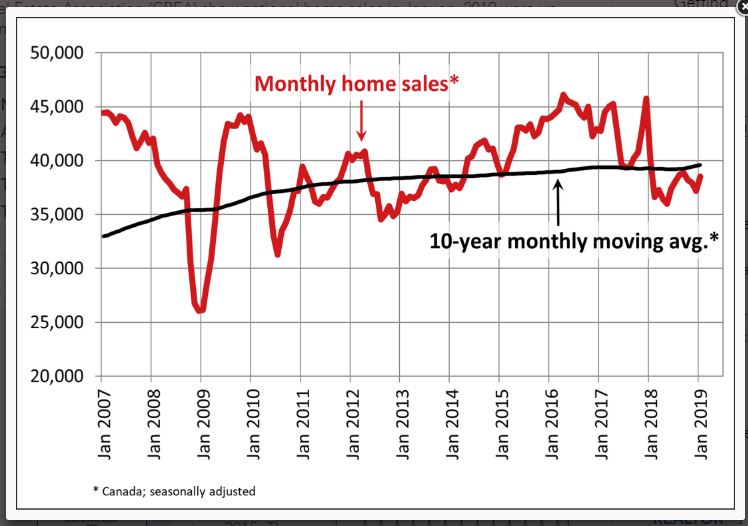
Statistics released today by the Canadian Real Estate Association (CREA) show that national home sales improved in January, climbing 3.6% from December ’18 to January ’19. Last year’s annual sales were the weakest since 2012.

As the chart below shows, national monthly home sales remain below their 10-year moving average and are decidedly lower than in the boom years of 2016 and 2017. Households are still adjusting to the tightened mortgage qualification rules introduced in January 2018. The number of homes trading hands was up from the previous month in half of all local markets, led by Montreal, Ottawa and Winnipeg.

Actual (not seasonally adjusted) sales were down 4% from year-ago levels and posted the weakest January since 2015. Year-over-year (y/y) sales were below the 10-year average for January on a national basis and in British Columbia, Alberta, Saskatchewan, Ontario and Newfoundland & Labrador.

Housing market conditions remain weakest in the Prairie region, and the Lower Mainland of B.C. Housing has been more fragile than the Bank of Canada expected, notwithstanding the tighter mortgage regulations combined with previous actions by provincial governments and CMHC to slow housing activity. The slowdown in housing has contributed meaningfully to the weakness in Canadian economic activity.
New Listings

The number of newly listed homes edged up 1% in January, led by a jump in new supply in Greater Vancouver and Hamilton-Burlington.

With sales up by more than new listings, the national sales-to-new listings ratio tightened to 56.7% compared to 55.3% posted in December. This measure of market balance has remained close to its long-term average of 53.5% for the last year.

Based on a comparison of the sales-to-new listings ratio with the long-term average, more than half of all local markets were in balanced market territory in January 2019.

There were 5.3 months of inventory on a national basis at the end of January 2019, in line with its long-term average. That said, the well-balanced national reading masks significant regional differences. The number of months of inventory has swollen far above its long-term average in Prairie provinces and Newfoundland & Labrador; as a result, homebuyers there have an ample choice of listings available for purchase. By contrast, the measure remains well below its long-term average in Ontario and Prince Edward Island, consistent with seller’s market conditions. In other provinces, sales and inventory are more balanced.

Home Prices
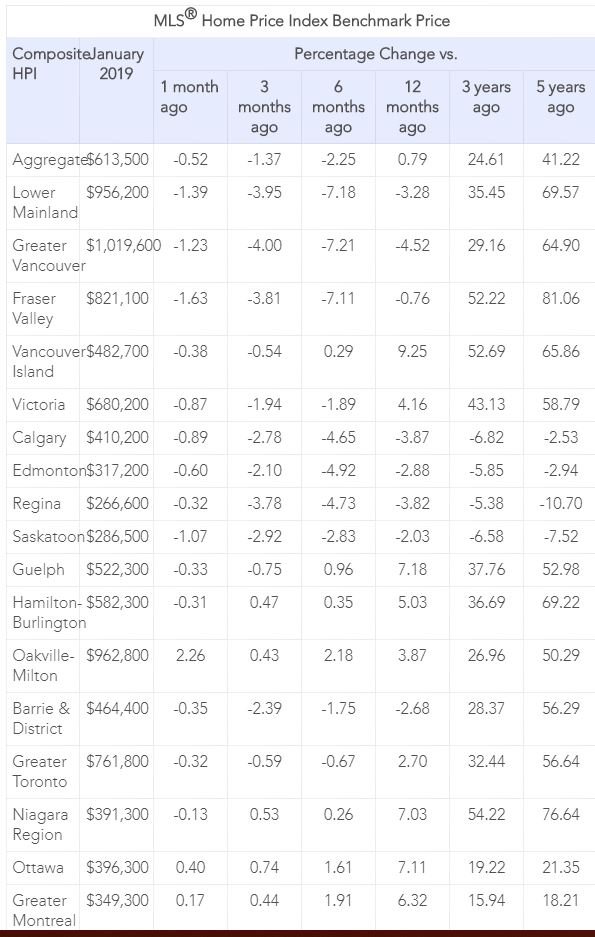
The Aggregate Composite MLS® Home Price Index (MLS® HPI) was up 0.8% y/y in January 2019 – the smallest increase since June 2018.

Following a well-established pattern, condo apartment units recorded the largest y/y price increase in January (+3.3%), followed by townhouse/row units (+1.5%). By comparison, two-storey single-family home prices were little changed (+0.1%) while one-storey single-family home prices edged down (-1.1%).

Trends continue to vary widely among the 17 housing markets tracked by the MLS® HPI. Results were mixed in British Columbia. Prices were down on a y/y basis in Greater Vancouver (-4.5%) and the Fraser Valley (-0.8%). By contrast, prices posted a y/y increase of 4.2% in Victoria and were up 9.3% elsewhere on Vancouver Island.

Among housing markets tracked by the index in the Greater Golden Horseshoe region, MLS® HPI benchmark home prices were up from year-ago levels in Guelph (+6.8%), the Niagara Region (+6.8%), Hamilton-Burlington (+6.4%), Oakville-Milton (+3.3%) and the GTA (+3%). Home prices in Barrie and District remain slightly below year-ago levels (-1.1%).

Among Greater Golden Horseshoe housing markets tracked by the index, MLS® HPI benchmark home prices were up from year-ago levels in Guelph (+7.2%), the Niagara Region (+7%), Hamilton-Burlington (+5%), Oakville-Milton (+3.9%) and the GTA (+2.7%). By contrast, home prices in Barrie and District remain below year-ago levels (-2.7%).

Across the Prairies, supply is historically elevated relative to sales, causing benchmark home prices to remain down from year-ago levels in Calgary (-3.9%), Edmonton (-2.9%), Regina (-3.8%) and Saskatoon (-2%). The home pricing environment will likely remain weak in these cities until elevated supply is reduced.

Home prices rose 7.1% y/y in Ottawa (led by a 9.5% increase in townhouse/row unit prices), 6.3% in Greater Montreal (led by a 9.2% increase in townhouse/row unit prices) and 1% in Greater Moncton (led by a 15.1% increase in townhouse/row unit prices). (see Table 1 below).

Bottom Line

The Bank of Canada meets again on March 6th and it is highly unlikely they will hike interest rates. The Canadian economy has been burdened with a weakened oil sector, reduced trade and a weak housing market. Although job growth has been stronger than expected, wage gains have moderated and inflation pressures are muted.

We are likely in store for a prolonged period of modest housing gains in the Greater Golden Horseshoe, stability or softening in much of British Columbia and further weakening in the Prairies, Alberta, and Newfoundland & Labrador.

Sluggish sales and modestly rising prices nationally are likely in prospect for 2019. While there will still be some significant regional divergences, there is no need for further policy actions to affect demand. Indeed, a growing chorus has been calling for lowering the mortgage qualification rate from the posted five-year fixed rate, currently 5.34%, to closer to the actual conventional rate, about 200 basis points lower.
Dr. Sherry Cooper

DR. SHERRY COOPER

Chief Economist, Dominion Lending Centres

18 Feb

High Ratio And Conventional Mortgages

General

Posted by:

HIGH RATIO AND CONVENTIONAL MORTGAGES

There are two different types of mortgages when it comes to their balance in relation to the value of your home- high ratio or conventional.

When you applying for a mortgage, lenders use a ratio called loan to value. Your loan to value is exactly what it sounds like, the size of your mortgage in relation to the value, written as a percentage.

For example, if you have a $500,000 home and your mortgage is $300,000 and your down payment/equity is $200,000, your loan to value is 60%. This means that the bank owns 60% of your home and you technically own 40%, because if your house sold for $500,000, you would only get $200,000 as the remaining amount goes to the lender to pay out your mortgage.

When some one says high ratio and conventional mortgages, that is referring to your loan to value. If your loan to value is more than 80%, you have what is called a high-ratio mortgage. A high-ratio mortgage is when you own less than 20% of your home. You will also be required by law to pay what is called mortgage default insurance to help protect the lender if you were unable to maintain your mortgage payments.

A conventional mortgage is when you own 20% or more of your home and your mortgage amount is less than 80% of the value of your home. You do not need to pay mortgage insurance premiums if you purchase a home with 20% or more as well. When refinancing your home and borrowing against your equity, lenders are not allowed to increase your mortgage to an amount above 80% of your homes value. This means, if you own less than 20% of your home, you cannot refinance or take equity out.

You are also not allowed to purchase a rental property and receive a high ratio mortgage as you are required to put 20% down. Conventional and high ratio mortgages will also affect your interest rates as most lenders incentives high ratio buyers to work with them by offering lower interest rates.

There are several other categories when looking at loan to value and what each one can give you in terms of borrowing power, however, when it comes to high ratio and conventional, these are the biggest differences.

If you have any questions relating to high ratio or conventional mortgages, contact your local Dominion Lending Centres mortgage professional.

Ryan Oake

RYAN OAKE

Dominion Lending Centres – Accredited Mortgage Professional

18 Feb

Canadian Jobs Surge In January As Jobless Rate Rises To 5.8%

General

Posted by:

CANADIAN JOBS SURGE IN JANUARY AS JOBLESS RATE RISES TO 5.8%.

Housing News

January Data From Local Real Estate Boards

In separate releases, the local real estate boards in Canada’s largest housing markets released data this week showing home sales fell sharply in Vancouver, edged upward in Toronto and continued robust in Montreal. Overall, higher interest rates, the mortgage stress test and in the case of Vancouver, measures adopted a year ago by the BC and municipal governments still keep many buyers on the sidelines.

In Vancouver, home sales are in a deep slump, declining 39% year/year in January, though they were up 3% month/month. Sales in January were the weakest for that month since 2009–the depth of the financial crisis. Hardest hurt were sales of luxury properties.

The Vancouver benchmark price fell 4.5%, which was the most significant decline since the recession. The area’s composite benchmark price now has decreased by 7.7% since the cyclical peak in June 2018.

The number of listings rose sharply from a year earlier as sellers rushed to market fearing further price declines. In Vancouver, supply-demand conditions now favour buyers.
Toronto home sales edged higher in January, rising 0.6% year/year. Sales were up 3.4% compared to December 2018. The benchmark price rose 2.7% compared to January 2018. The condo apartment market segment continues to lead the price gains. Toronto area supply-demand conditions remain balanced.

Montreal saw a 15% year/year increase in sales last month. Demand remains robust as the number of active listings fell sharply. Benchmark prices of single-family homes increased 3% year/year, while condos prices rose 2%.

Montreal is now a highly desirable sellers’ market, which is especially true in the single-family home segment in direct contrast to the underperformance of that sector in the GVA and the GTA over the past year.

CMHC Says Overvaluation Decreasing But Housing Still ‘Vulnerable’

The Canada Mortgage and Housing Corporation (CMHC) said this week that the country’s overall real estate market remains ‘vulnerable’ despite an easing in overvaluation in cities like Toronto and Victoria in the third quarter of 2018. CMHC is using old data, as we already have numbers through yearend 2018 and preliminary data for January, all showing that overheating in Toronto and Vancouver has dissipated.

Many Calling for Mortgage Stress Test Review

Local real estate boards, mortgage professionals’ trade groups and some economists are calling for some relief on the stringency of the federal regulator’s mortgage stress test. According to Phil Moore, president of the Real Estate Board of Greater Vancouver, “Today’s market conditions are largely the result of the mortgage stress test that the federal government imposed at the beginning of last year. This measure, coupled with an increase in mortgage rates, took away as much as 25% of purchasing power from many homebuyers trying to enter the market.”

Economists at CIBC and BMO this week highlighted that the tightened qualification requirements for mortgage applicants had slowed activity measurably. While raising the qualification rate by 200 basis points might have made sense eighteen months ago, when housing markets were red hot in Vancouver and Toronto and interest rates were at record lows, we are in a very different place in the economic cycle today.

The Bank of Canada has raised the overnight benchmark policy rate by 75 basis points since the introduction of the new measures, which begs the question of whether 200 basis points is still the right number.

The Office of the Superintendent of Financial Institutions (OSFI) introduced the B20 rules in January 2018 aiming to thwart a credit bubble amid inflated household debt burdens and frothy housing markets. The new rules force people who want a new uninsured mortgage to demonstrate they can manage payments at rates two percentage points above what’s being offered by a lender. The new rules have been very effective in cooling household borrowing and reversing the gains in overheated housing markets.

Indeed, mortgage growth has shrunk to a 17-year low in Canada. Residential mortgage growth was posted at 3.1% in December from a year earlier, the slowest pace since May 2001, and half the growth rate of two years ago.

The slowdown in housing has had a material effect on the economy as a whole. Weakened economic growth has moved the Bank of Canada to the sidelines. While the Bank is now more cautious in jacking up the policy rate to a neutral level, the residential mortgage market is now–in a stress-test perspective–well into restrictive territory. For example, the Bank’s policy rate is at 1.75% (well below the 2.5% rate the BoC considers neutral), while posted mortgage rate used for stress testing is at 5.34%.

This week, OSFI defended the B20 rule suggesting that “The stress test is, quite simply, a safety buffer that ensures a borrower doesn’t stretch their borrowing capacity to its maximum, leaving no room to absorb unforeseen events.”

Canadian Job Market Surges in January

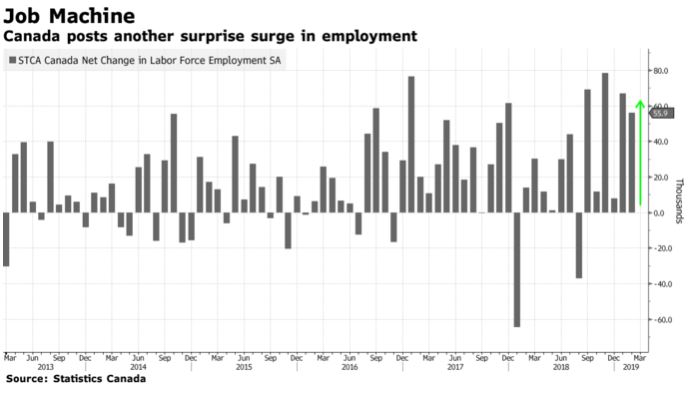
Statistics Canada released its January Labour Force Survey this morning showing employment increases of 66,800 versus expectation of merely a 5,000 job gain. The surge was led by record private-sector hiring and service sector jobs for youth. This is good news for an economy facing considerable headwinds in the oil sector, weakening housing activity, volatile financial markets and falling consumer confidence. If sustained, the strong employment data will ease some concerns about the length and depth of the current soft patch.

Even with the strength in job creation, the unemployment rate jumped 0.2 percentage points to 5.8% as more people looked for work–a sign of strength. This suggests there is more capacity in the economy before inflation pressures begin to mount–a big point for the Bank of Canada. Economic growth is now hovering around 1%, but the Bank of Canada expects it to recover to about a 2% pace in the second half of this year. The central bank will remain on the sidelines until it can verify that a rebound is occurring.

Wage gains remained depressed, a key indicator for the Bank. Average hourly wages were up 2% from a year ago, with pay for permanent employees up 1.8%.

Alberta, which has been flattened by slumping oil prices and production cuts, posted a second consecutive monthly decline in employment. Ontario led the job surge followed by Quebec.

Provincial Unemployment Rates
(% 2019, In Ascending Order)

Province                                                  Jan        Dec
British Columbia                                   4.7         4.4
Quebec                                                    5.4         5.5
Saskatchewan                                        5.5         5.6
Manitoba                                                5.5         6.0
Ontario                                                    5.7         5.4
Alberta                                                    6.8         6.4
Nova Scotia                                            6.9         7.0
New Brunswick                                     8.2         8.4
Prince Edward Island                          9.9         9.6
Newfoundland and Labrador          11.4        11.7

Dr. Sherry Cooper

DR. SHERRY COOPER

Chief Economist, Dominion Lending Centres

18 Feb

Reading This Could Save You Money (How To Renew Your Mortgage In 5 Easy Steps)

General

Posted by:

READING THIS COULD SAVE YOU MONEY (HOW TO RENEW YOUR MORTGAGE IN 5 EASY STEPS)

If you have a mortgage, chances are unless you win a lottery (cha-ching $$$) you’ll be doing a mortgage renewal when your current term has finished.

While most Canadians spend a lot of time, and expend a lot of effort, in shopping for an initial mortgage, the same is generally not the case when looking at mortgage renewals.

So what is a mortgage renewal?

Mortgages are amortized* over a set term* which can vary from 1-10 years.

About 6 months before the end of your term, your current lender will suddenly become your “Best Friend” showering you with attention and trying to entice you with early renewal offers… Please, please, please Mortgage borrower, sign here on the dotted line to renew… it’s sooo easy!!

You have 3 options

  1. Sign and send back as is (don’t do it, really I mean it… don’t do it!!)
  2. Check the market to make sure you are getting the best rate and renegotiate with your current lender
  3. Talk to your friendly neighbourhood Dominion Lending Centres Mortgage Professional and together we can discuss the best options available for your situation.

Lenders know that 80% of people will sign their renewal forms, because it’s easy. Banks & Lenders are a business and as such they want to make the highest profits to keep their shareholders happy. As an educated consumer, you need to take the time to ensure you are being offered the best possible rate & terms you can get. Remember all those hours of research you did regarding lenders and mortgage rates when you were buying your first home?

Yes, signing the renewal document is easy, however, it’s in your best interest to take a more proactive approach. Money in the lenders pocket comes directly out of your pocket… so its time to get to work!

5 steps to save you money on your mortgage renewal

  1. Receive the renewal offer from your current mortgage lender and examine immediately, which gives you enough time to make an informed decision.
  2. Do your research via the internet and phone calls to find out about current rates.
  3. Phone your current lender and negotiate!
  4. If your lender will not offer you a better rate then it’s time to move your mortgage. YES, you will have to complete a mortgage application and gather documentation, just like you did for your original mortgage.
  5. Take a look at your budget and see if you can increase the amount of your mortgage payments above the mandatory payments and save money by paying off your mortgage quicker.
    Your mortgage is one of your biggest expenses. For this reason, it is imperative to find the best interest rates and mortgage terms you possibly can.

As you can tell there is lots to discuss about mortgage renewals.

To save money, call a DLC mortgage broker to help you shop your mortgage around at renewal time.

Kelly Hudson

KELLY HUDSON

Dominion Lending Centres – Accredited Mortgage Professional

18 Feb

What Questions To Ask When Considering A Refinance

General

Posted by:

WHAT QUESTIONS TO ASK WHEN CONSIDERING A REFINANCE

Many of my clients and friends regularly ask me when or if they should consider a refinance. Here are 4 quick questions that I ask of them. The answer they give me, will very quickly tell me if we should be taking a deeper look at the mortgage refinance options available to them.

What do you believe the current value of your home is and what is the outstanding balance on your mortgage?
Have you ever heard your mortgage broker or banker talk about “loan to value”(LTV)? They are looking to determine what your outstanding balance of your mortgage is as a percentage of your property value. The reason we look at your LTV is because there are limits in Canada with respect to how large your mortgage can be based on the current value of your home. This gives your mortgage broker insight into how much equity or money you have access in the event that you were to refinance your mortgage.

What is the maturity date of your mortgage and your current rate/term length?
Understanding who your current lender is, what your maturity date is, and what your rate/term details are, will help your mortgage broker determine what type of penalty you might have for breaking your current mortgage contract. Knowing your rate will also give them the details they require to calculate the interest savings that you would receive from a refinance. When looking to refinance, your mortgage broker should be factoring these potential costs and overall interest savings into their overall benefits analysis when trying to determine if refinancing is the right option for you.

How is your household monthly cash flow impacting your short and long term financial goals?
Budget, budget, budget… this is one of those tools that we all know we should do, but it often gets very little of our attention each month. By understanding how much net income you have coming in each month and where that cash is going (cash flow) we can look at how a restructured mortgage could help. If you are finding that all of your money is disappearing each month and you’re having trouble getting by, a new mortgage can help restructure your monthly debt payments giving you some added breathing room. It is important to note that sometimes it is not about debt payments and it can be about high household expenses. Taking the time to assess your spending and cutting it back if necessary, might be enough to get you back on track. Check out our blog post on basic budgeting tips and tricks.

Looking at your outstanding debt, what are the current interest rates that you are paying and are you only making the minimum payments each month?
A quick snap shot of your current debt load, respective interest rates and monthly payments can give us some insight into how a refinance can save you interest. By understanding what your financial picture looks like and the amount of interest that you are currently paying to service that current debt, we can very quickly estimate how much interest you could save with a refinance. If you take a number of those high interest rate credit cards and roll them into a new, low interest rate mortgage, the savings can very quickly become quite substantial.

In closing, a refinance is a financial tool that can make a significant difference in your current financial picture. If you have reviewed the questions above and would like to take a closer look at your situation, there is never a better time than the present to make a change that will have a positive impact on your future.

Take the time to have a conversation with a Dominion Lending Centres mortgage broker who can give you some insight into how a new mortgage could help you with a brighter financial future.

Nathan Lawrence

NATHAN LAWRENCE

Dominion Lending Centres – Accredited Mortgage Professional

29 Jan

Winter Is Here! Get A Worry Free Mortgage!

General

Posted by:


WINTER IS HERE! GET A WORRY FREE MORTGAGE!

This time of year, there are a few less mortgage’s being done- not many people want to move into a new home in the snow. But if you want to get a worry free mortgage, this is a great time to be shopping.

Scope out those potential neighbourhoods – how many snow shovels?

  • Will my new neighbours shovel their driveways?
  • Are there any super nice people on the street willing to snow-blow my sidewalk?
  • Can I walk around safely?
  • Are they using salt, sand or kitty litter to de-ice the walk?
  • How far is this house located from a bus route or major traffic route that will get plowed first when we have a lot of snow?

My top tip? Scope out that neighbourhood right after it snows – compare early morning snow levels to slightly after work snow levels. In some neighbourhoods you can drive around and count how many people have shovels ready near their front door.

And if you closely examine sidewalks, try looking right between two homes – this can tell you if two people shoveled at different times – or if that super nice multiple driveway shoveler exists in this neighbourhood! That’s what I call a worry free mortgage!

What? You need more than just good neighbours with shovel’s to have a worry free mortgage?
You want the best interest rate, or to confirm that you’ve got a mortgage that let’s you pay it off faster? Well, a Dominion Lending Centres mortgage broker will help with that. Give us a call to get those details in place!

Jillian Napen

JILLIAN NAPEN

Dominion Lending Centres – Office Manager

29 Jan

First Time Home Buyers

General

Posted by:

FIRST TIME HOME BUYERS

Your First Home. What a THRILLING thing that is to think about!! One of the best parts about our job is helping individuals purchase their first home. We know that the process can seem daunting at first, but we have an in-depth understanding and knowledge of what steps are required to make the process go smoothly. Follow these and you will be turning the key into your new home before you know it.

1. Find a Fantastic Mortgage Broker
Finding a mortgage broker who can help with your pre-approval process can allow you to determine the price point of home you can really afford. Finding a mortgage broker right off the bat can also give you an advantage over working with your bank:

  • Mortgage Brokers work for you, not the bank or lender
  • They have access to multiple lenders and are not limited to one single product
  • They are an expert in the field. They focus on mortgages and mortgages alone!

2. Get Comfortable With The Numbers
There are two numbers that all first-time homebuyers should keep in mind: 39 and 44. These two numbers can help you budget and determine what you can truly afford when looking to purchase a home. Why 39 and 44? Here’s why:

  • A maximum of 39% of your total income can go towards your housing costs. This will cover your mortgage payment, property tax payment, heating costs, and strata fees.
  • A maximum of 44% of your total income can go towards your housing costs and total debt payments. This will include ALL housing costs and all debt repayments (credit cards, car loans, student loans, etc.)

Now, here are a few other key numbers that can help you in your house hunting:

3. Know What Your Down Payment Needs to Be
You know the numbers, now let’s look at what you need to know about the down payment itself. First, if you have less than 20% down payment your mortgage will be insured and have insurance premiums added to your mortgage. If you are considering putting the minimum down, that would be 5% if the property is worth $500,000 or less. A down payment of 10% is required for any amount over $500,000. Here’s a quick example of what this looks like:

Purchase Price of $600,000

5% of $500,000                                   $25,000

10% of $100,000                                             $10,000

Total Down Payment:                                   $35,000

4. Take Advantage of The RRSP Home Buyers Plan
The Canadian government’s Home Buyers’ Plan (HBP) allows for first time home buyers to borrow up to $25,000 from you RRSP for a d own payment, tax-free! You are able to combine this with your partner if you are both first time home buyers you can both access the $25,000 from your RRSP for a combined total of $50,000. Certain qualifications do apply for you to use this plan, we have laid them out here for you to review.

5. Don’t Forget About the Closing Costs!
This is one so many people overlook! Closing costs are something that can add up quickly when you are purchasing a home. Here is an approximate breakdown of the funds you will need:

  • Legal Costs: $1000
  • Title Insurance: $200
  • Appraisal: $350
  • Property Transfer Tax: Pending on purchase price

An additional few facts on property tax for you to consider:

This is an approximation of what your closing costs may be, but it is always good to budget for them beforehand.

6. Have your Documents Ready to Roll
Mortgages = paperwork! There are a number of documents that you will need to have to give to your mortgage broker. This will vary depending on your employment situation and where your down payment is coming from, but here is a general list you can follow:

  • Most Recent paystub
  • Letter of Employment
  • NOA’s (2 years)
  • T4’s (2 years)
  • Down payment verification—up to 3 months of bank statements
  • Contract of Purchase and Sale (Your realtor will provide this)
  • Property Disclosure Statement (Realtor will provide)
  • if you are self-employed you may also have to show:
    o T1 Generals
    o Articles of Incorporation
    o Financial Statements

7. Start Working on Your Credit Score
Yes, your credit score does directly impact your ability to get a mortgage. Lender’s want to see that you can responsibly manage credit and debt repayment before loaning you a large sum of money to purchase a home. Your credit score will be a determining factor in the terms and rate associated with your mortgage.

Just what impacts your credit score? Good question! Here are a few things:

  • Late payments will lower your score
  • Collections, judgements, consumer proposals, bankruptcy this will lower your score
  • Exceeded limits on credit cards
  • Ideally, you will be able to show a minimum of 2 active and current trade lines
  • The longer your trade line is, the better increase in your score!
  • Lenders also like to see a minimum of $2,000 limit on your credit cards.

Understanding and using this knowledge can help make your first home buying experience a great one! Once you have gone through the pre-approval process with a mortgage broker the fun part begins! Upon you receiving your preapproval, you can begin the house hunting. From there, you can put an offer on your dream home (yay!) Once your offer is accepted, we go through the mortgage process with you and then it’s moving day for you!

This is an exciting time for first time homebuyers—we enjoy getting to help our clients go from start to finish and helping them get the keys to their first ever home. If you have questions or are looking to find out just how much you will qualify for you can check out our mortgage calculator OR you can reach out to a Dominion Lending Centres mortgage professional directly!


Geoff Lee

GEOFF LEE

Dominion Lending Centres – Accredited Mortgage Professional

15 Jan

2018 Is In The Books, Here Are The Q4 Numbers!

General

Posted by:

2018 IS IN THE BOOKS, HERE ARE THE Q4 NUMBERS!

2018 was a challenging year for the housing and mortgage market—new regulations, rate increases and more made it one of the toughest years for homeowners to qualify. Despite all this, there was still $45.3 billion in collective profits made by the Big Six Banks (Bank of Montreal, CIBC, National Bank of Canada, Royal Bank of Canada, Scotiabank and TD Bank).

Profits for the big banks were up an average of 13% over last year, however their stock prices were down across the board. Here’s the key points from each of the 6 major banks.

What can we expect in 2019? In general, the banks are forecasting increased mortgage growth, but there are also lowered expectations of Bank of Canada rate hikes this year which could impact net interest margins negatively.

From the Big Bank reports there were areas that stood out:

1. BMO: predictions of increasing 1-2 bps per quarter, dependent on certain moves and choices required to do so. Source: BMO conference call
2. CIBC: RESL growth has slowed, but they are predicting an increase in their mortgage portfolio in line with where we see the overall market growth trending. Source: CIBC Conference Call
3. National Bank of Canada: 2018 completed their repositioning of their distribution model translating to higher levels of mortgage originations and renewals. They saw a year over year increase in amortizing HELOCS due to consumers choosing to lock in their rates. Source: NBC Conference Call
4. RBC: Increase in mortgage portfolio of 5% year over year, with a growth in the range of 3-5% for 2019. They feel they have a strong renewal rate in comparison to other banks. HELOC products have shrunk for RBC as clients at renewal looking to lock in our residential mortgage. Source: RBC Conference Call
5. Scotiabank: expecting increased margins supported by higher interest rates. Residential mortgages are also expected to grow at mid-single digits in 2019. Source: Scotiabank Conference Call
6. TD Bank: mid-single digit growth for their proprietary total real estate secured lending portfolio in 2019. They are expecting a rate of growth a little bit lower in the first half, but mid-single digits for the full year. Source: TD Conference Call.

Do you still have questions regarding the 2019 Mortgage Market or the Q4 wrap-up? Dominion Lending Centres mortgage professionals are well versed in the in’s and out’s of the mortgage market and would be happy to walk you through the full details.

Stat Sources: https://www.canadianmortgagetrends.com/2019/01/q4-2018-bank-earnings-mortgage-morsels/


Geoff Lee

GEOFF LEE

Dominion Lending Centres – Accredited Mortgage Professional

15 Jan

A Shifting Market…Again

General

Posted by:

A SHIFTING MARKET… AGAIN

The recent data sure has changed the tone of rates in the coming months.

The prime rate – what variable rates are based on, while a few short weeks ago was expected to rise three times in the next 18 months now with the data on the slowing of the market and uncertainty in projects moving forward as expected, there are signs increases could be delayed until next spring.

The bond market- what fixed rates are based on, has dropped, which means rates (after the banks have hung on as much as possible ) should come down slightly.

What does his mean for borrowers? Let’s break it down per segment

1- Homebuyers – more affordability due to the recent dip in prices – pending price category anywhere from 10-30%. Remember, working with an unbiased mortgage professional we do a full look back upon closing to ensure the lowest cost of borrowing.

  1. Home sellers – price sharp if you want to sell or else no point in being on the market.
  2. Renewals rejoice – payment shock shall be reduced upon renewal.
  3. Those carrying debt outside of a mortgage ex: credit cards, car payments, lines of credit – now is your time to see how much money moving that debt into a new restructured mortgage will improve your cash flow. It’s the most effective strategy for protecting your credit.

The most constant theme in everything above: The market is always changing, yesterday’s news is exactly that. Aligning yourself with the frontline experts who will help you with clarity in the ever-changing market. This is why while experts can give you the data on the current market – it’s always subject to change. The decisions a borrower makes is their responsibility to adapt to. If you have any questions, contact your local Dominion Lending Centres mortgage professional.

Angela Calla

ANGELA CALLA

Dominion Lending Centres – Accredited Mortgage Professional

15 Jan

3 Things For Every Homeowner To Do In January

General

Posted by:

3 THINGS FOR EVERY HOMEOWNER TO DO IN JANUARY

As we enter the New Year, there are a few things that we should all think about as homeowners.

1 – Replace your furnace air filter – if you read over the instructions for your furnace you will know that you are supposed to either clean or replace your furnace filter. We are three months into the heating season so a replacement now will last you until spring.

2 – Put a copy of your last pay stub for last year with your house papers & keep an eye out for your annual mortgage statement – put this statement in with your house papers along with your last pay stub.

3 – Check all your credit card balances before they are due – as the holiday season has just ended , you may have spent more money than you have in your bank account. If there’s a shortfall between what you can pay and what you owe you will now be stuck with a credit card balance with an interest rate of 19-25%.
There’s a solution. If you have enough equity in your home, you can apply through your mortgage broker for a home equity line of credit (HELOC). This is a readvanceable account and should have an interest rate of closer to 4% . Remember you still owe this money but it’s a lot easier to pay off a balance when the interest compounds at 4% rather than 25%.
Contact your favourite DLC mortgage broker and ask them if you qualify for this money saving option. The first thing that your broker will ask you is for a mortgage statement and your last pay stub from last year which you will have easily at hand. Now there are just a few more steps and you are on the way to getting your holiday debts into a manageable situation . Dominion Lending Centres providing solutions to Canadians.

David Cooke

DAVID COOKE

Dominion Lending Centres – Accredited Mortgage Professional