9 Jan

What’s in Store For 2019?

General

Posted by: Livian Smith

WHAT’S IN STORE FOR 2019?

At the start of every New Year, pundits posit the forecast as everyone wonders what the year will bring. While no one has a crystal ball, here are some fundamentals at play this year:

1). Canada’s economy will continue to under perform the U.S. as growth slows to 1-3/4% in 2019 compared to just over 2% in 2018. For the U.S., where budget deficits have been rising sharply with the 2018 tax cuts, growth this year will hit about 2.4% compared to nearly 3% last year–an over-heated economy to say the least.

2.) Canada’s population growth will lead the G7 by a wide margin. In 2018, Canada’s population was on track to increase 1.4%, the most robust pace in 18 years and double the 0.7% rate for the U.S., which was the G7 country with the next-highest population growth rate. Despite this, spending did not rise —auto sales fell on an annual basis for the first time since 2009, while home sales had their second biggest slide in the past 20 years. Per capita GDP growth in Canada this year will under perform most of the G7.

Strong (net) immigration accounted for almost half (45%) of Canada’s population increase last year. That contribution will only grow since Ottawa has committed to boosting its annual immigration target from 310,000 new permanent residents in 2018 to 331,000 this year (up 6.7%) and to 350,000 by 2021. About two-thirds of 2019’s expansion will come from the immigration programs that target highly skilled workers aimed at addressing labour shortages across Canada.

As well, the number of non-permanent residents reached an all-time high of 166,000 last year accounting for one-third of the growth in the population. This group includes temporary foreign workers, international students and asylum seekers. All three categories soared, reflecting strong demand for skilled labour, Canada’s growing reputation as a desirable place to obtain post-secondary education, and increases in cross-border refugee claimants.

3.) Canadian consumers are tapped out as debt levels remain high, interest rates edging upward and credit is less readily available. Boomers are wary that their homes are worth less than what they were counting on as Canada’s two largest housing markets experienced decade-low sales last year with softer prices especially at the pricier end of the single-family home market. First-time buyers might have more homes to choose from in some markets, but regulators have tightened qualification rules. Foreign buying has slowed owing to foreign purchaser taxes in Toronto and Vancouver and speculation taxes in Vancouver.

4.) The Fed and the Bank of Canada will raise rates in 2019 by more than the market currently expects. Market participants in recent weeks have reduced expectations for rate hikes by both central banks to barely one increase apiece. More likely, both the Fed and the BoC will raise the benchmark overnight rate twice each this year. Even with these actions, monetary policy in both countries will be slightly accommodating with interest rates still below neutral levels.

5.) Even with only modest rate increases in 2019, consumers will be impacted because they are so heavily exposed to debt. Economists at the Royal Bank estimate that the average household faces a $1,000 hit from rate hikes. This would imply that the average household principal and interest payment will increase by 7.6% in 2019.

6.) This effect will be offset by stronger wage growth as labour markets continue to tighten. Labour shortages will finally add to wage growth. The unemployment rate hit a record low in December, yet wage growth had slowed to only 1.5% year-over-year, well below inflation. Over the next decade, more than 270,000 people will retire from the Canadian labour market every year. Immigrants and temporary workers will replace some of these retirees, but not all.

Recent data suggest that the quit rate–the proportion of the labour force that leaves their jobs voluntarily–is rising. This portends higher wage rates going forward.

7.) Rising interest rates will squeeze government spending for the feds and provinces with significant debt loads. Ottawa will spend more on debt payments than any other program except elderly benefits.

8.) Corporate balance sheets will be negatively impacted by higher interest rates as Canadian companies borrowed more heavily than their international counterparts. Canadian companies remain less competitive as their productivity growth has lagged their global competitors. Efforts to improve Canadian competitiveness are in process but have yet to show meaningful results. This has been a secular problem for Canada.

9.) Canada could be caught in the crosshairs of a U.S.-China trade war, but free-trade deals with Europe (CETA) and China (CPTPP) will reap benefits, particularly as the U.S. continues to alienate many of its allies and trading partners. Canada must diversify trade away from the U.S., particularly in the oil sector, which requires massive infrastructure spending. No longer can we count on exports of oil and transportation products to the U.S. to be the mainstay of Canadian global trade.

10). Comparable to last year, housing in 2019 will not fuel Canada’s national economy, thanks to macroprudential policy measures and modestly higher interest rates. Housing accounted for a record-high percentage of overall economic growth and job creation until early last year.We are barely off those peak levels now, so any slowdown in housing activity will have a disproportionately large negative impact on the economy–the flip side of its disproportionate expansionary impact over much of the prior decade.

Bottom Line: Sales to new listings have stabilized in Toronto, but continue to decline in Vancouver. Population growth in Vancouver has under performed Toronto’s for two years, while supply, mainly in the high-rise segment, has risen sharply. In consequence, the number of completed and unabsorbed units in Vancouver continues to increase, while that measure is still trending downward in Toronto. The sector of most significant weakness in Toronto will continue to be in the pre-sale low-rise market where there remains considerable excess supply.


DR. SHERRY COOPER

Chief Economist, Dominion Lending Centres

9 Jan

Bank of Canada Remains on Hold, Revising Down Oil Market Outlook

General

Posted by: Livian Smith

BANK OF CANADA REMAINS ON HOLD, REVISING DOWN OIL MARKET OUTLOOK

The Bank of Canada left the overnight benchmark policy rate at 1-3/4%, as expected. In another dovish statement, the Bank of Canada acknowledged a slowdown in global economic activity and highlighted that oil prices are roughly 25% lower than what they had assumed in the October Monetary Policy Report (MPR). The lower prices primarily reflected sustained increases in U.S. oil supply and increased worries about global demand, especially in light of a potential U.S.-China trade war (see oil chart below).

The Bank also commented that these worries had been mirrored in bond and stock markets. Credit spreads off Treasuries have widened, and stock markets have sold off around the world (see chart below). Equity prices and bond yields have declined in the face of market unease over global growth. Volatility has risen, and corporate credit spreads have widened sharply. A tightening of corporate credit conditions is particularly evident in the North American energy sector reflecting the decline in oil prices.

Weak oil prices negatively impact the Canadian economic outlook and “transportation constraints and rising production have combined to push up oil inventories in the west and exert even more downward pressure on Canadian benchmark prices. While price differentials have narrowed in recent weeks following announced mandatory production cuts in Alberta, investment in Canada’s oil sector is projected to weaken further.”

The Bank acknowledged that the economy is running close to potential, unemployment is at a 40-year low and trade will likely improve with the weak dollar, the trade deal with Mexico and the U.S. (now dubbed “CUSMA”) and federal tax measures to target investment. Nevertheless, consumer spending and housing investment “have been weaker than expected as housing markets adjust to to municipal and provincial measures, changes to mortgage guidelines, and higher interest rates. Household spending will be dampened further by slow growth in oil-producing provinces.”

The contribution to average annual real economic growth from housing investment has been revised down to -0.1% this year from the +0.1% forecast in October.

The Bank of Canada revised down its forecast for real GDP growth in 2019 to 1.7%–0.4 percentage points lower than the October outlook. According to the Bank, “This will open up a modest amount of excess capacity, primarily in oil-producing regions. Nevertheless, indicators of demand should start to show renewed momentum in early 2019, leading to above-potential growth of 2.1% in 2020.”

Inflation remains close to 2%, the central bank’s target, having fallen to 1.7% in November, due to lower gasoline prices. While low gasoline prices will depress inflation this year, the weak Canadian dollar will have an offsetting impact on the CPI. On balance, the bank sees inflation returning to around 2% by late this year.

Considering all of these factors, the Governing Council continues to judge that the benchmark policy rate will need to rise over time to a neutral range to achieve the inflation target. “The appropriate pace of rate increases will depend on how the outlook evolves, with a particular focus on developments in oil markets, the Canadian housing market, and global trade policy.”

Bottom Line: The Bank of Canada for the first time admits in today’s MPR that the slowdown in the housing market has been more dramatic than the Bank’s staff had expected. The January MPR states, “provincial and municipal housing market policies, the tighter mortgage finance guidelines and higher mortgage rates continue to weigh on housing activity. Slowing of activity in some markets has been associated with less speculative activity. As a result, it is difficult to evaluate the sensitivity of non-speculative demand to the various policy changes. Monthly indicators have signalled that spending on housing likely contracted again in the fourth quarter. Weaker-than-expected housing activity in recent months and staff analysis suggest that the combined effect of tighter mortgage guidelines and higher interest rates has been larger than previously estimated. The Bank will continue to monitor developments in housing markets to assess how construction is adjusting to the shift in demand toward lower-value units.”

The Bank see less urgency to raise interest rates as the economy copes with slumping oil prices and weak housing markets. The five interest rate hikes since mid-2017 are having a more substantial impact on spending than the Bank expected. A short-term pause in rate hikes is now likely. The economy slowed considerably in the fourth quarter of last year, which will continue in the first quarter of this year owing to the decline in oil prices and the Alberta government’s implemented oil production cuts.

While it is unlikely that the Bank is finished its tightening this cycle, expect rates to remain steady until we see solid evidence of a rebound in the oil sector and in housing as interest-rate sensitivity of Canadians is at historical highs


Dr. Sherry Cooper

DR. SHERRY COOPER

Chief Economist, Dominion Lending Centres


9 Jan

9 1/2 Steps to Repair and Improve Your Credit

General

Posted by: Livian Smith

9½ STEPS TO REPAIR AND IMPROVE YOUR CREDIT

Though credit scores aren’t always an indicator of financial health, they are used in a variety of ways that could have a major impact on your life. Interest rates (including mortgage rates) are almost always determined by your credit score. Some employers & landlords may require a credit check to see if you have past credit issues.
Remember this is your credit report, not your “I’m Fiscally Responsible” report. Lenders want to know how you have historically handled credit in order to determine if you are a good credit risk. Higher risk = higher rates!

The Rule of Two:
• You should always have 2 “tradelines” going. This can be a combination of 2 credit cards OR a credit card and a line of credit/ loan etc.
• Credit lines should have a minimum $2,000 limit
• Minimum of 2 years old

So, if your credit score sucks, it could be costing you.
The good news is, you don’t have to live with bad credit forever. There are plenty of things you can do to improve your credit score. Use the 9½ tips below, to improve your credit score

#1) Know Your Credit Score and Credit History
Request a free copy of your credit report from both of Canada’s credit agencies (TransUnion and Equifax). You are legally entitled to one free credit report yearly from each credit agency. Check out my BLOG How to Get a FREE Copy of Your Credit Bureau

#2) Review both TransUnion & Equifax Reports for Any Errors or Discrepancies.
If you find any errors in your credit report, you should dispute them with Equifax or TransUnion and request to have them correct any errors.

#3) Pay On Time, EVERY time!
This might seem obvious, but you need to make your payments on time, every time! This is crucial to repairing and maintaining your credit rating. The largest percentage of your credit score is based on your payment history!! Even being a couple of days late will have a negative impact on your score. Staying current with your payments has a huge positive impact. If you can’t pay the balance off in full, pay the minimum amount on time!

#4) Don’t Go Over Your Card’s Credit Limit
Going over your credit limit, even once will have a huge negative impact on your credit score. You need to be aware of your credit limit and your current debt levels to avoid this.

#5) Pay Off Any Overdue Accounts ASAP
Paying off a collection account will not remove it from your credit report, so do your best to avoid going to collections. If you have any overdue accounts that have gone to collections, negotiate to pay them off ASAP.

#6) Reduce Your Debt
Easier said than done, but if you want to increase your credit rating, you need to reduce your debt. The closer you are to your credit limit, the lower your score. In a perfect world you only want to use about 30% of your available credit. If you have a lot of credit card debt you might consider a loan (with lower interest rates than the credit cards) to consolidate your debts.

#7) Limit Your Inquiries for New Credit
You lose points from excessive hard inquiries on your credit bureau. Any attempts to take on multiple loans/credit cards will look bad in your report.

#8) Avoid Closing Credit Cards
Account age is a factor that reflects positively on your credit score. Too many new accounts lowers your average account age and negatively impacts your credit score. For the same reason, you may want to keep an old account open, even if you are not actively using it.

#9) Time is your Friend
When rebuilding your credit, time will be your best friend. The impact of past credit problems lessens with time, so that a late payment from a year ago will have much less weight than a late payment today. Get current and stay current.

#9.5) Protect Your Credit from Identity Theft
As more of our personal information gets circulated via the internet, there’s more room for “bad people” to steal your personal details so that they can make fraudulent purchases in your name. This can be extremely damaging to your credit history. You can protect your credit history from this by paying for a service that can alert you to fraud.

If you have any questions, contact a Dominion Lending Centres mortgage broker near you.

Kelly Hudson

KELLY HUDSON

Dominion Lending Centres – Accredited Mortgage Professional

8 Jan

Why We Worked With a Broker

General

Posted by: Livian Smith

We recently had a couple come into our office who we had worked with in 2011. They had some life changes that had occurred in the past 7 years and were unsure if they could make things work. They came back to speak with us and shared a little bit of their story and thoughts on working with a broker. Check out their story below! **Names Changed for privacy purposes**

Jane and her husband Kevin never in a million years would have thought that they could own a detached home in the Fraser Valley. One look at the market and they felt “stuck” where they were in their two-bedroom townhome in Kamloops, British Columbia. They had purchased their townhome in 2011 by working with us at Dominion Lending Centres.

They loved their little home but a job opportunity for Kevin opened up and the need for more space (with baby #2 on the way) was pulling them towards the Fraser Valley. Now they had their doubts about being able to afford a house in the Lower Mainland. They had strong credit and very little debt, but there is always the “unknown” when you are looking at buying a home. They decided to reach out to their us again—and we were all in to make their dream become a reality!

After a few weeks of shopping around they found a picture-perfect home in the Valley for $675,000—and were able to move in just last month (just in time for the holidays!)

When asked why they opted to work with a broker, they said it was due to the ability of Mortgage Brokers being a “One stop shop”—no shopping around from bank to bank or having to have your information pulled and sent off to several different lenders. It was all done for them. They were able to send all of their information and let us do the rest. And the best part for Jane and Kevin? We got them a great rate back in 2011 and were able to do the same in 2018!

Why else should you choose to work with a broker instead of the bank? Just a few reasons for you…
1. A broker can access rates that your bank can’t. They can access:
i. Tier 1 banks in Canada
ii. Credit Unions
iii. Monoline Lenders
iv. Alternative Lenders
v. Private Lenders

This extensive network allows brokers to ensure that you are not only getting the sharpest rate, but the mortgage product is also aligned with the client’s needs.

2. A broker will negotiate on your behalf, directly with a lender. There is no “grunt work” needed on your part—your mortgage broker does it all for you.
3. A Mortgage Broker can produce and show you several different options so that you can select the optimal product for your specific needs. A broker won’t just look at the rate, they will also look at:
i. Prepayment options
ii. Costs of Borrowing
iii. Portability
iv. Blending and Extending
v. Penalty to break
4. A broker can save you some serious cash! Because they have access to a multitude of different lenders and can offer discounts the bank can’t people end up saving money when they work with a mortgage broker.
5. Working with a broker means you have someone on your side—always. Mortgage Brokers will work to provide you with industry information and updates long after your mortgage is completed. They want to make sure that the product that was right for you when you signed is still the right one for you today and in the future.

Mortgage Brokers are a dedicated group of individuals who work directly for the client, not the lenders or the bank. Brokers are problem-solvers, advisors and honourable individuals. We work hard to give our clients the best that we can in an industry that constantly is evolving and changing.

Kevin and Jane made the right choice working with us here at DLC.

Geoff Lee

GEOFF LEE

Dominion Lending Centres – Accredited Mortgage Professional

8 Jan

How to Renew Your Mortgage in 5 Simple Steps!

General

Posted by: Livian Smith

HOW TO RENEW YOUR MORTGAGE IN 5 SIMPLE STEPS!

If you have a mortgage, you’ll be completing a mortgage renewal when your current term has finished.
While most Canadians spend a lot of time and expend tons of effort shopping for an initial mortgage, the same is generally not the case when looking at mortgage renewals.

So what is a mortgage renewal?

Mortgages terms are locked in rates that are *over a set term* which can vary from 1-10 years.

About 3 months before the end of your term, your current lender will suddenly become your best friend showering you with attention and trying to entice you with early renewal offers…And the first offer is never their best. It really shows how they value the relationship.
“Please, please sign here on the dotted line to renew… it’s sooo easy!!”

You have 3 options

1. Sign and send back with no alterations or changes (don’t do it, really I mean it… don’t do it!!)
2. Check the market to make sure you are getting the best rate and renegotiate with your current lender
3. Talk to a mortgage expert and together we can discuss the best options available for your situation

Lenders know that 80% of people will sign their renewal forms because it’s fast, easy and convenient. Banks & lenders push this “take it as it is” tactic to borrowers to ensure they make the highest profits to keep their shareholders happy. As an educated consumer, you need to take the time to ensure you are being offered the best possible rate & terms you can get.
Remember all those hours of research you did regarding lenders and mortgage rates when you were buying your first home… don’t forget!
It is true that signing the renewal document is easy, however it is in your best interest to take a more proactive approach. Money in the lenders pocket comes directly out of your pocket.

5 steps to save you money on your mortgage renewal

1. Receive the renewal offer from your current mortgage lender and examine immediately. This gives you enough time to make an informed decision
2. Do your online research about the best current rates for you
3. Call your current lender and negotiate!
4. If your lender will not offer you a better rate then it is time to move your mortgage. You will have to complete a mortgage application and gather applicable documentation just like you did for your original mortgage, but we will help with most of the work!
5. Take a look at your budget and see if you can increase the amount of your mortgage payments. This will eventually save you money by paying off your mortgage faster

Your mortgage is one of your biggest expenses. For this reason, it is so important to find the best interest rates and mortgage terms you possibly can.
As you can tell there is lots to discuss about mortgage renewals. We can help. Contact a Dominion Lending Centres mortgage professional today!

Chris Cabel

CHRIS CABEL

Dominion Lending Centres – Accredited Mortgage Professional

28 Dec

Canadian Home Sales Weakened Further In November

General

Posted by: Livian Smith

CANADIAN HOME SALES WEAKENED FURTHER IN NOVEMBER

Statistics released today by the Canadian Real Estate Association (CREA) show that national home sales dipped for the third consecutive month, down 2.3% from October to November and down a whopping 12.6% year-over-year. Transactions declined in just over half of all local markets, with lower activity in the Greater Toronto Area (GTA), the Greater Vancouver Area (GVA) and Hamilton-Burlington offsetting increased sales in Edmonton. Sales were down from year-ago levels in three-quarters of all local markets, including the Lower Mainland of British Columbia, Calgary, the GTA and Hamilton-Burlington.

These data suggest a double-digit national sales decline in 2018, falling to its lowest level in five years even though the economy is reaching full employment. Next year’s growth in sales and prices will likely be moderated by recent policy changes from different levels of government, in addition to upward pressure on interest rates.

Many had expected a rebound in sales in British Columbia, but so far it has not materialized. The rebound in sales in Ontario last summer has now run its course and activity in Alberta has edged lower. Housing transactions in Quebec, in contrast, were strong.

New Listings

The number of newly listed homes fell by 3.3% between October and November, with new supply declining in roughly 70% of all local markets.

With new listings having declined by more than sales in November, the national sales-to-new listings ratio tightened slightly to 54.8% compared to 54.2% in October. This measure of market balance has remained close to its long-term average of 53.4% since the beginning of 2018.

Based on a comparison of the sales-to-new listings ratio with the long-term average, about 60% of all local markets were in balanced market territory in November 2018. There were 5.4 months of inventory on a national basis at the end of November 2018. While this remains in line with its long-term average of 5.3 months, the number of months of inventory is well above its long-term average in the Prairie provinces as well as in Newfoundland & Labrador. By contrast, the measure is well below its long-term average in Ontario, New Brunswick and Prince Edward Island. In other provinces, sales and inventory are more balanced.

Home Prices

The Aggregate Composite MLS® Home Price Index (MLS® HPI) was up 2.3% y/y in October 2018, down once again on a month-over-month basis.

Following a well-established pattern, condo apartment units posted the largest year-over-year price gains in November (+6%), followed by townhouse/row units (+4%). By comparison, one-storey single-family homes posted a modest increase (+0.4%) while two-storey single-family home prices held steady (+0.1%).

Trends continue to vary widely among the 17 housing markets tracked by the MLS® HPI. In British Columbia, home price gains have been steadily diminishing on a y/y basis in the Fraser Valley (+4.7%) and Victoria (+7.2%). By contrast, price gains picked up elsewhere on Vancouver Island (+12.6%) and, for the first time in five years, were down (-1.4%) from year-ago levels in the GVA. On a month-over-month basis, prices fell 1.9% in Greater Vancouver in November, the most since 2008, adding to the recent series of price declines in Canada’s most expensive housing market.

Among housing markets tracked by the index in the Greater Golden Horseshoe region, MLS® HPI benchmark home prices were up from year-ago levels in Guelph (+9.3%), the Niagara Region (+7.2%), Hamilton-Burlington (+6.3%), Oakville-Milton (+3.4%) and the GTA (+2.7%). Meanwhile, home prices in Barrie and District remain below year-ago levels (-2.1%).

Across the Prairies, benchmark home prices remained below year-ago levels in Calgary (-2.9%), Edmonton (-1.9%), Regina (-4%) and Saskatoon (-0.3%). Excess supply of listings relative to demand will continue to put downward pressure on prices until economic activity in the region strengthens.

In contrast, home prices rose 6.6% y/y in Ottawa (led by a 7.3% increase in two-storey single-family home prices), 6.2% in Greater Montreal (driven by a 9.4% increase in townhouse/row unit prices) and 4.2% in Greater Moncton (led by an 11.2% increase in townhouse/row unit prices). (Table 1)

The actual (not seasonally adjusted) national average price for homes sold in November 2018 was just over $488,000, down 2.9% from the same month last year.

Sales in Greater Vancouver and the GTA, two of Canada’s most active and expensive markets, bias upward heavily skew the national average price. Excluding these two markets from calculations cuts almost $110,000 from the national average price, trimming it to just over $378,000.

Bottom Line

We are likely in store for a prolonged period of modest housing gains in the Greater Golden Horseshoe, stability or softening in British Columbia and further weakening in the Prairies, Alberta, and Newfoundland & Labrador.

The Canadian housing market has slowed considerably since mid-2017 and is ending the year on a quiet note. Two offsetting forces are impacting housing—strong population growth and rising rates. Sluggish sales and modestly rising prices nationally are likely in store for 2019. While there will still be some significant regional divergences, there is no need for further policy actions to affect demand.

Dr. Sherry Cooper

DR. SHERRY COOPER

Chief Economist, Dominion Lending Centres

11 Dec

Mortgage Prepayment(s)- The Perfect Holiday Gift!

General

Posted by: Livian Smith

MORTGAGE PREPAYMENT(S)- THE PERFECT HOLIDAY GIFT!

Do you know what kind of prepayment privileges you currently have with your mortgage? Does your current lender allow you to make a 10% prepayment or a 20% prepayment on your principle amount? Can you double your monthly payment? Or can you even increase the amount you are paying monthly?

This is important information, and the following break down is going to show you why making a prepayment on your mortgage may just be the best holiday gift you can get yourself this season!

Mortgage Structure

Mortgage Amount: $400,000

Term: 60 months (5 years)

Interest rate: 3.19%

Payment: $1,932.19/month


After 5 years of monthly payments…


Interest paid: $59,068.97

Principal paid: $56,862.43

Balance outstanding: $343,137.57

Amortization remaining: 20 years


After 5 years of monthly payments with double-up payments twice yearly…


Interest paid: $57,621.44

Principal paid: $77,631.86

Balance outstanding: 322,368.14

Amortization remaining: 20 years

Effective amortization: 15 years 1 month

Interest saved over term: $1,447.53


Let us break this down. If you double your monthly payment of $1,932.19 twice a year, for the term of your mortgage (5 years in this case), you will save $1,447.53 in interest over those 5 years. Not too bad. But there is more…

If you did these double-ups twice a year for 5 years, and refinanced your mortgage after the 5 years but continued paying the higher payment of $1,932.19 instead of what the new monthly payments would be ($1,557.19), that extra $375 a month goes directly to the principal amount owing and takes 4 years and 11 months off of your amortization…

If that doesn’t excite you and you decided instead to continue making double-up payments for the remainder of the amortization, you would save $38,550.70 in interest…

So this holiday season, when you get your year-end bonus or are deciding how much to spend on loved ones, maybe first consider allowing yourself a mortgage prepayment or two because it could save you years of payments and potentially thousands of dollars in interest! If you have any questions, contact a Dominion Lending Centres mortgage professional near you.

Ryan Oake

RYAN OAKE

Dominion Lending Centres – Accredited Mortgage Professional
Ryan is part of DLC Producers West Financial based in Langley, BC.

11 Dec

Canadian Jobless Rate Fell To A 42-Year Low In November

General

Posted by: Livian Smith

CANADIAN JOBLESS RATE FELL TO A 42-YEAR LOW IN NOVEMBER

With so much bad news coming out about the economy, Statistics Canada this morning posted a blockbuster jobs report, mitigating worries about the health of the economy.

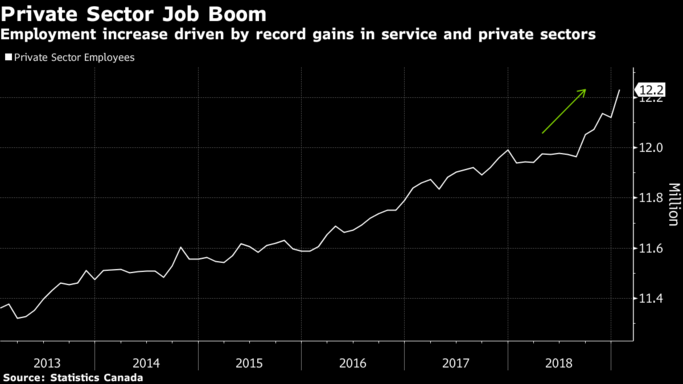
Employment increased by a whopping 94,100 in November, led mostly by full-time jobs that were broadly based across industries. This was the largest monthly jobs gain in records dating back to 1976. The unemployment rate fell to 5.6%, also the lowest in the data, from 5.8% in October.

The strength in employment was unexpected as economists forecast a gain of only 10,000. Just this week, the Bank of Canada painted a picture of an economy facing substantial headwinds, warning of turmoil in the oil sector, government ordered oil production cuts in Alberta and a potential U.S.-China trade war. Since Wednesday’s central bank decision to hold rates steady announced in a decidedly pessimistic press release, markets had been pricing in only one rate hike in 2019.

Some analysts pondered whether the rate-hiking cycle is already over after five increases since the middle of 2017. “My bet is the BoC is done, period,” David Rosenberg, chief economist and strategist at Gluskin Sheff + Associates Inc., told clients in a report this week.

In a speech on Thursday, Governor Poloz reiterated his view that the Bank will eventually need to bring the current 1.75% policy rate back into “neutral range” of somewhere between 2.5% and 3.5%–noting the environment of low unemployment, inflation close to target and an economy close to full capacity utilization.

The strong November labour force report certainly keeps a January rate hike on the table for now, but only if it is confirmed by strengthening incoming economic indicators and no reversal in the December jobs report.

The Canadian dollar rallied on the news–having dropped appreciably in the previous three days–and market interest rates edged upward for the first time in a week and a half. The five-year government bond yield, an important indicator of five-year fixed mortgage rates edged up three basis points, offsetting a bit of the monthly decline.

Even the oil-producing hub of Alberta showed strength, adding 23,700 jobs on the month and pushing down the unemployment rate by a full percentage point to 6.3%, near its lowest since 2015 (see chart and table below).

Employment rose in six provinces, led by Quebec, Ontario and Alberta, and was little changed in the four Atlantic provinces. In Ontario, employment increased by 20,000 compared with October, the result of gains in full-time work. The number of unemployed was little changed and the unemployment rate held steady at 5.6%. The number of employed people in British Columbia grew by 16,000 in November. The unemployment rate rose 0.3 percentage points to 4.4%. There were 5,500 more employed people in Saskatchewan. The unemployment rate declined by 0.7 percentage points to 5.5%, the second decrease in three months. In November, there were 2,600 more Manitobans employed. The unemployment rate fell 0.4 percentage points to 5.7%, as fewer people searched for work.

The private sector dominated the employment gains last month as more people worked in professional, scientific and technical services; health care and social assistance; construction; business, building and other support services; transportation and warehousing; and agriculture. At the same time, fewer people worked in information, culture and recreation. Employment in construction increased by 15,000, led by gains in British Columbia and tempered by a decline in Newfoundland and Labrador. Year over year, employment was little changed in the industry.

Employment increased for both core-aged women and men (aged 25 to 54), as well as for older people (aged 55 and over)—driven by men.

Jobs in the Cannabis Industry

For the first time, Stats Canada reported cannabis-related jobs. Non-medicinal cannabis became legal in Canada on October 17, 2018. The number of people employed in these jobs in November was 10,400, an increase of 7,500 (+266%) from 12 months earlier. The majority (58%) of cannabis-related employment in November was in the agriculture sector, where workers performed duties such as bud trimming. The rest of the hiring was spread across a number of other industries such as educational services, health care, and retail trade.

More men than women worked in these jobs (79% compared with 21%). The median age was 35 years, younger than the median for workers in non-cannabis-related jobs (40 years). Virtually all of the employees were working full time and had permanent positions. The highest level of cannabis-related employment was in Ontario, an estimated 5,700, representing more than half of the national total. Ontario is the province with the largest concentration of licensed producers.

Wages Weakened

The one negative component of the November labour report was the slowdown in the growth of wages. Annual gains decelerated sharply to 1.7% in November– the slowest growth since July 2017–compared to a 2.2% clip the prior month. Wage gains for permanent workers were 1.5%, also the slowest in more than a year. This compares to 3.1% year-over-year wage growth in the U.S.

The U.S. Posted Weaker Than Expected Jobs and Wages in November

U.S. jobs and wages rose by less than forecast in November while the unemployment rate held at the lowest in almost five decades, indicating some moderation in a still-healthy labour market.

Nonfarm payrolls increased by 155,000 after a downwardly revised 237,000 gain in the prior month, a Labor Department report showed Friday. The median estimate in a Bloomberg survey called for an increase of 198,000. Average hourly earnings rose 0.2% from the prior month, compared with forecasts for 0.3%, though wages matched projections on an annual basis, up 3.1% for a second month.

Tariffs began to bite as employment gains at primary and fabricated metals manufacturers edged upward, but people who use those metals like auto and auto parts manufacturers saw job cutbacks.

Christmas hiring did not match last year’s pace as retail jobs rose by 18,000 roughly 10,000 fewer than this time last year, mostly at department stores. These gains were offset in part by job declines at furniture stores, clothing and accessories stores, electronics and appliance stores, and bookstores. This might have had something to do with online shopping uptrends as couriers and messenger jobs increased significantly.

The broader measure of unemployment known are U-6, or the underemployment rate rose to 7.6% from 7.4%. This measure includes part-time workers who want a full-time job and people who are less active in seeking work.

Dr. Sherry Cooper

DR. SHERRY COOPER

Chief Economist, Dominion Lending Centres
Sherry is an award-winning authority on finance and economics with over 30 years of bringing economic insights and clarity to Canadians.

10 Dec

The #1 Misconception About Mortgage Financing!

General

Posted by: Livian Smith

THE #1 MISCONCEPTION ABOUT MORTGAGE FINANCING!

It is a reoccurring but common misconception that you will qualify for a mortgage in the future because you have qualified for a mortgage in the past.

This is not accurate!

Do. Not. Assume. Anything.

Even if your financial situation has remained the same or has improved, securing mortgage financing is more difficult now than it has in recent years.
The latest changes to mortgage qualification by the federal government has left Canadians qualifying 20-25% less. On top of that, guidelines that lenders would use in determining your suitability have been replaced with non-negotiable rules and declarations.

As mortgage professionals, we keep up to date with the latest trends going on in the mortgage world by understanding lender products and staying attentive to evolving changes.

From experience, we can tell you that having a plan is crucial to a successful mortgage application. Making assumptions about your qualification or just “winging it” is a recipe for disaster. Here are a few points on why a mortgage broker is a must for the first time home-buyer.

1. They have access to over 40 different lenders, not just one
2. They work for you, not for the lender
3. They will guide you through the application process
4. They save you valuable time by shopping for you
5. They pull your credit once — if you go to multiple banks, you will have multiple credit pulls

If you are thinking about buying a property, please feel free to contact a Dominion Lending Centres mortgage professional where we can help you devise a full-proof plan!

Chris Cabel

CHRIS CABEL

Dominion Lending Centres – Accredited Mortgage Professional
Chris is part of DLC HomeHow Mortgage based in Calgary, AB.

10 Dec

Why Reverse Mortgages are Bucking the Downward Trend

General

Posted by: Livian Smith

WHY REVERSE MORTGAGES ARE BUCKING THE DOWNWARD TREND

The reverse mortgage market in Canada has been increasing at a phenomenal rate over the last few years.

In fact, for HomeEquity Bank, the provider of the CHIP Reverse Mortgage, growth was well over 40% in August, bringing Canada’s outstanding reverse mortgage balance to $3.03 billion.

Compare this to the latest growth in lending for new and renewal mortgages at just 4.1% – this is the lowest since May 2001. Much of this slow-down in mortgage growth is a result of the introduction of the new mortgage stress test, which has made it harder for borrowers to qualify for the mortgage they need, as well as a significant jump in mortgage interest rates.

So, how is it that reverse mortgages are growing so much faster than conventional mortgages? And who is driving this growth?

The reverse mortgage solution and why it matters to you

The CHIP Reverse Mortgages allows you to tap into the equity of your home is available to Canadians aged 55 and over. The key difference from a regular mortgage is that borrowers don’t have to make any regular repayments. This means they can have a considerable injection of cash without having to pay off what they owe until they sell or move out of their home.

The number of Canadians over 65 has jumped by 20% since 2011, so the potential market for reverse mortgages has grown enormously in just a few years.

Life expectancy is now at almost 83 and more people are living into their 90s and beyond 100 than ever before. Retirement can now easily last 20 years or more, which can put a big strain on retirement savings. Many retirees are therefore having to look at ways to supplement their retirement income.

There are many reasons for taking out a reverse mortgage. These include paying off high interest debt, maintaining a good standard of living, improving or retrofitting their home and helping family out financially.

Canadians prefer to stay in their homes during retirement

A recent Ipsos/HomeEquity Bank survey revealed that a staggering 93% of Canadians aged 65+ are determined to stay in their homes during retirement, rather than downsize or move in with relatives or into a care home.

Almost 70% said that maintaining their independence was the most important reason for staying at home. Others also want to stay close to their family, friends and community.

Downsizing is an increasingly unpopular option

While downsizing has often been seen as a key strategy for accessing some home equity, its popularity is declining. Another Ipsos survey revealed that 48% of homeowners don’t plan on downsizing and that 39% are skeptical that downsizing would actually save them any money. People who regretted downsizing said the key reasons were missing their old neighbourhood, family and friends, which can play a big role in emotional well-being in your later years.

Nevertheless, 31% of retirees say they need to cash in on their home’s equity to live comfortably in retirement. So, if they don’t want to downsize, what are their options?

How the reverse mortgage helps out retirees

The introduction of the mortgage stress test has made it even harder for retirees to qualify for the kind of mortgage they need to effectively improve their finances.

Even those that do qualify often struggle to make the monthly payments required from a conventional mortgage or line of credit. A reverse mortgage provides them with tax-free cash that enable retirees to live the retirement they want, with no negative impact on their monthly income. For many retirees, a reverse mortgage is the only option available to them that provides them with the finances they need without regular required payments.

If you would like to find out more about the CHIP Reverse Mortgage and how it could help improve your retirement finances, contact your Dominion Lending Centre mortgage professional.

Rebecca Burgum

REBECCA BURGUM

HomeEquity Bank – Director, Referred and Product Marketing