9 Apr

7 Steps To Buying A Home

General

Posted by: Livian Smith

7 STEPS TO BUYING A HOME

It’s important to understand the home buying process, so here’s a 7-step checklist.

Step 1: Down Payment
The hardest part to buying a home is saving the down payment (a gift from the Bank of Mom & Dad also works).
• For purchases under $500,000 minimum down payment is 5%.
• Buying between $501-999,000 you need 5% on first $500,000-PLUS 10% down payment for anything over $500,000.
• Buying a home over $1 million you need 20% down payment.

For any home purchases with less than 20% down payment, you are also required to purchase Mortgage Default Insurance.

Step 2: Strategize, Define Your Budget and get Pre-Qualified
Unless you can afford to buy a home, cash in hand, you are going to need a mortgage.
You need to get pre-qualified, which should not be confused with the term pre-approved.
The big difference is that no approval is ever given by a lender until they have an opportunity to examine the property that you wish to purchase. The bank may love you… but they also must love the property you want to buy.
Pre-qualifying will focus on gathering documentation to prove the information on your mortgage application including credit, debt load, income/employment, down payment etc.

Mortgage brokers will make sure you get a great mortgage rate. Just as important as rates are the terms of your mortgage which should include:
• prepayment options (10-20%)
• penalties
• portability
We also discuss what type of mortgage fits your current situation
• fixed vs variable?
• life of the mortgage (amortization) 25 or 30 years etc.
• payments – monthly, semi monthly, accelerated bi-weekly

Step 3: Set Your Budget
Keep in mind that just because you’re pre-qualified for a certain amount of mortgage, doesn’t mean you can actually afford that amount. Prepare your own monthly budget to be sure.
Typically, your total home payments (including mortgage, property taxes, strata fees & heat) should not exceed 32-39% of your gross (pre-tax) income.

Step 4: Find the Right Property – Time to Engage a Realtor
Once you have been prequalified for a mortgage, based on your budget… you need to find a realtor.
Selecting the right real estate agent is a very important step in the home buying process. When you work with an agent, you can expect them to help you with many things, including:
· Finding a home
· Scheduling tours of homes
· Researching the market, neighbourhood and home itself
· Making and negotiating your offer to purchase, and counter-offers
· Providing expert advice on home buying
· Handling the offer, gathering documentation and closing paperwork
I recommend interviewing at least three realtors. You will quickly decide who has your best interests in mind. Do you want to deal directly with a realtor who’s going to work with directly when you go home hunting, or do you want to deal with a BIG name realtor, who has buyers & sellers realtors working under them? There are advantages to each – you need to decide what is the best fit for your situation.
Get referrals for realtors from friends and family… OR ask me, I have a group of realtors that I know and trust.

Step 5: Mortgage Approval
Once you have found the property you would like to call home, your mortgage broker will send your mortgage application and property information to the lender who is the best fit for your situation, based on your input.
If the lender likes your financial situation and the property, they will issue a “commitment” letter outlining the terms of the mortgage. The lender will send you a list of documents, so they can verify and validate all the information you told them on the mortgage application.

Step 6: Time for the Solicitor (Lawyer or Notary)
Once the lender has reviewed and approved all your mortgage documentation and the property documentation, your file will be sent to your solicitor (in B.C. you can use a lawyer or notary). They will process all the necessary title changes and set up a time for you to meet, review mortgage documents and sign.

Step 7: Get the Keys
On the closing day the documentation for your home purchase will be filed at the land titles office by your solicitor. Typically, the possession date is 1 or 2 days later, giving time for the money (down payment & mortgage) to get to the home seller. On possession day you set up a time to meet with your realtor to get the keys.
Congratulations you’re done – you now own your home!!

Mortgages are complicated, but they don’t have to be… speak to a Dominion Lending Centres mortgage broker!

Kelly Hudson

KELLY HUDSON

Dominion Lending Centres – Accredited Mortgage Professional

9 Apr

Source Of Funds

General

Posted by: Livian Smith

SOURCE OF FUNDS

Over the past several years, investigators have been working on an ongoing investigation relating to criminal money laundering in Canada. Looking at B.C. alone, billions of dollars have been laundered through B.C. casinos by criminal organizations and parked in high end B.C. real estate over the past decade or more.

With government citing limited resources and a lack of funds available to conduct a proper investigation, criminals have been able to manipulate and take advantage of the Canadian and B.C. legal system for years and it is now finally coming to light the impact it has had on our economy, most notably our real estate market.

One of the measures the government implemented several years ago to help crack down on this was sourcing the funds people were using for the down payment on their home purchases. Lenders are required by the federal and provincial government to collect a minimum of 30 days of transaction history for every bank account where money comes from to help complete a purchase on real estate. Most lenders are still requiring 90 days and they are also required, by the government, to source any large deposits above $1,000 that are unrelated to employment income.

If you have e-transfers and transfers between your own accounts within the 90 day period, the lender will require a 90 day history of the account in which funds were deposited from. That means, if you have a savings account reserved just for a down payment, but you put $1,000 a month in there from your chequing account, brought in $5,000 from a TFSA, and put in $3,000 in cash all before you wrote an offer on a home, a lender is going to want to see 90 day history of your savings, your chequing, and your TFSA account as well as an explanation on where the $3,000 cash came from.

Most people find this frustrating and rightfully so, you are handing over personal information over a long period of time. However, due to the extreme affect money laundering has had on our economy, these rules are likely not going anywhere. When preparing your down payment, be prepared that the lender will be required to collect a 90 day history of every account you have where money is coming from to help cover your down payment. This is not because the lender feels like it, this is because the government regulators who review the loans the banks give out need to see that the lender verified the money was legitimate.

Also, with your T4’s and Notice of Assessments usually going into lenders, if you are just starting a new job and were making $20,000 a year while in school and now have $150,000 in savings for your down payment a year out of school, the lender is allowed to ask for a full year history because your income does not justify the savings you have.

Be prepared! Lenders are required to source down payment funds and with more and more news coming out every month on money laundering, the rules may only get more rigid. If you have any questions, contact a Dominion Lending Centres mortgage professional near you.

Ryan Oake

RYAN OAKE

Dominion Lending Centres – Accredited Mortgage Professional

9 Apr

March Jobs Report In Canada Finally Mirrors Weak Economy

General

Posted by: Livian Smith

MARCH JOBS REPORT IN CANADA FINALLY MIRRORS WEAK ECONOMY

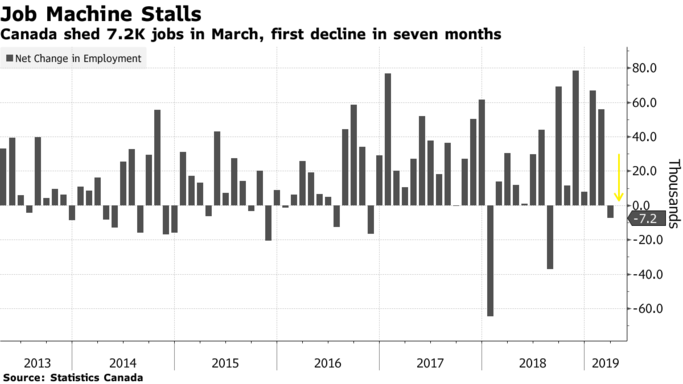
The employment report had long been a lone bright spot in an economy that had sunk across the board, so the March slump is not surprising. According to today’s jobs report from Statistics Canada, employment fell by 7,200 last month, mostly in full-time positions in the service sector. Canada’s jobless rate held steady at 5.8%, close to a multi-decade low and wage growth ticked modestly higher, although, at a 2.4% year-over-year gain, it remains lower than the reading earlier this cycle.

Employment was up 290,000 over the prior six months, so it was only a matter of time that the jobs numbers would reflect the weakness in the overall economy.

Provincial Unemployment Rates
(% 2019, In Ascending Order)
Province Mar Feb
British Columbia 4.7 4.5
Saskatchewan 4.9 5.8
Manitoba 5.0 5.3
Quebec 5.2 5.3
Ontario 5.9 5.7
Nova Scotia 6.2 6.4
Alberta 6.9 7.3
New Brunswick 7.9 8.5
Prince Edward Island 8.9 10.3
Newfoundland and Labrador 11.5 11.8


Bottom Line: The Bank of Canada will remain on hold and possibly even cut interest rates if the economy slows further. There is little evidence that underlying inflation trends will rise. The headwinds of global uncertainty, weak trade, energy market vulnerability and the housing slowdown contribute to the Bank’s cautious stance.

In another trade loss, China has stopped buying Canadian canola seeds. About 40% of Canadian canola seed exports usually go to China. The Huawei dispute and potential Meng Wanzhou extradition has escalated trade tensions between Canada and China, seriously hurting Canadian farmers. As well, the US tariffs on steel and aluminum exports continue to weigh on the economy. It appears there is little prospect that the renegotiated Canada-Mexico-US trade deal will be confirmed by the US Congress this year, adding to the uncertainty.

All of this has led some to begin calling for a Bank of Canada rate cut. Higher interest rates alongside regulatory changes have already contributed to significantly slower household debt growth and housing markets.

Housing Markets Remain Soft in March in Vancouver and Toronto

According to local real estate boards reporting this week, the end of winter did not spark a flurry of home buying in Vancouver and Toronto. Fragile market conditions deteriorated further in Vancouver where policy measures introduced by all levels of government continue to keep buyers on the sidelines. Home resales fell to their lowest level since 1986 (down another 7% from February), and the benchmark price eased for a ninth-straight month (down 8.5% since the June 2018 peak). Property values in the GVA are likely to remain under intense downward pressure in the near term.

March activity was the slowest in 10 years in Toronto. Resales increased a little less than 2% month-over-month (on a preliminary seasonally-adjusted basis)—minute in comparison to the 13% month-over-month drop in February. A lack of supply could have been a factor holding back activity as new listings fell 4.5% from a year ago. This possible explanation finds some support in the fact that the benchmark price rose at a faster pace in March (2.6% y/y) than February (2.3%)—suggesting that buyers had to bid more aggressively in the face of limited supply.

This winter has been particularly hard on residential real estate markets across most of Canada. The March results published in the last couple of days in Vancouver and Toronto—as well as in Victoria, Calgary and Hamilton—offer little in the way of a meaningful rebound during the all-important early spring season. While recent declines in mortgage rates and the new first-time home buyer incentive announced in the 2019 federal budget could be catalysts for a rise in activity later this year, the stress test and other market-cooling policy actions will continue to weigh heavily on buyers.

We will have more complete data on housing mid-month when the Canadian Real Estate Association releases national and local data.

Dr. Sherry Cooper

DR. SHERRY COOPER

Chief Economist, Dominion Lending Centres

9 Apr

Income Qualified

General

Posted by: Livian Smith

INCOME QUALIFIED

There are several different ways a borrower can qualify for a mortgage when it comes to their income. One of the most common ways is known as income qualified. All of the following methods of employment income are under the income qualified umbrella:

  1. Annual salary income employees
  2. Full time employees working guaranteed weekly hours
  3. Part time employees working guaranteed weekly hours
  4. Auxiliary/On-call employees with 2-yr history at same employer
  5. Commission Sales who have 2-yr history in same job/industry
  6. Employees earning gratuities who have claimed over 2-yr history
  7. Contract employees with 2-yr history at job/industry

There are a couple more types of employment that may fall into this category, but for the most part, these are the types of borrowers whose mortgage application is going to be done using income qualifying.

When it comes to the first 3, a borrower’s income is paid by a business in which they generally do not have any interest/ownership in. This means, an human resources representative or a supervisor can write a letter of employment stating the weekly guaranteed hours, the guaranteed hourly pay rate, the start date, and the employee’s position. The lender will then use this letter, a most recent pay stub, as well as verbally confirm the letter with the employer to verify a borrower’s income. This is how a borrower who works guaranteed hours or salary has their income verified and qualified on a mortgage application.

For numbers 4 to 7, lenders and mortgage brokers will verify and qualify a borrowers income a little differently. Because an employer does not guarantee hours or income, we need to see that there has been at least a 2-year history making the same amount. This 2-year history will usually need to be with the same employer and will need to be documented on your personal income tax returns to the Canadian Revenue Agency. The income amount on your line 150 of your T1 General Tax Returns for the past 2 years are added together and then divided by 2. The amount you get is the income you are allowed to use on your mortgage application and this is then verified by a letter of employment stating you have in fact been an employee there for more than 2 years, your are currently working there, your position, as well as a pay stub showing year-to-date income that is comparable to your 2-year average given the month you are in.

The same process would be used for those who earn over time or bonuses, claim tips, or work part time with two jobs. If you have any questions, contact a Dominion Lending Centres mortgage professional near you.

Ryan Oake

RYAN OAKE

Dominion Lending Centres – Accredited Mortgage Professional

2 Apr

Interest Rate Cut more Likely Than Hike In 2019

General

Posted by: Livian Smith

INTEREST RATE CUT MORE LIKELY THAN HIKE IN 2019

When the Bank of Canada decided this month to keep its benchmark interest rates stable at 1.75%, it signalled the weakening economy makes it unlikely a rate increase is anywhere on the horizon.

Inflation is not where it should be, we’re not in a deflation mode right now, but inflation is under control and there’s no real need for them to raise interest rates.

Because many of the economic indicators are pointing downward, this puts the bank in a position where it can’t raise rates. This makes refinancing a more attractive option for some homeowners this year.

A lot of economists are saying that Canada is heading back into another crisis, which is an indicator that rates may drop again. This new norm will probably stay around for a little while, but rates will eventually go up. And when it goes up, people have to be obviously prepared for it.

So, for now, homeowners shouldn’t worry too much about a sudden jump in rates. While this may be a new normal, if the economy begins a turnaround, they should be ready or a bump in rates, but I don’t think it’s going to happen the next couple of years.

Usually, Canada’s economy runs almost parallel to that of our southern neighbour’s. However, the two economies seem to have gone their separate ways lately.

There’s a divergence right now that is going to occur between the Canadian and U.S. economies. When people talk about the U.S. sneezing and Canada catches a cold—this is not what’s happening right now. There’s a divergence in the interest rates. Where in the States rates are going up, in Canada, rates cannot go up because of the way our economy is actually going.

The news isn’t all positive for Canadian homeowners though. Read our recent blogs on why too many Canadians are now ineligible for mortgages and why Montrealers in particular will see their municipal tax bills rise in the coming years. If you have any questions about mortgages, contact your nearest Dominion Lending Centres mortgage professional near you.

Terry Kilakos

TERRY KILAKOS

Dominion Lending Centres – Accredited Mortgage Professional

2 Apr

A Bank That May Not Be Familiar To You

General

Posted by: Livian Smith

A BANK THAT MAY NOT BE FAMILIAR TO YOU

Quiz time! Who is the largest non-bank mortgage originator in Canada with over $100 billion dollars in mortgages under administration? Answer – First National Financial Corporation. If you’ve never heard of them before, don’t feel bad. The only way to get a First National mortgage is through the broker channel. They do not have any branches anywhere in Canada. How did First National become #1?
Service – First National are fast. They will accept your application, underwrite it and if approved you will get a response within 4 hours. The industry average is 24 hours. Mortgage brokers use First National for clients who have very good credit salaried income and need an approval or pre-approval quickly.

Another nice feature of First National is that they will provide pre-approvals. Many lenders do not want to spend the time and money to provide these but First Nat have always provided pre-approval that are underwritten. What this means is that an underwriter has reviewed your application and if everything in it is straight forward they foresee no problems with an approval for the specified amount of money.

Additionally, if the home you are purchasing is 5 years old or older, a First National mortgage may be for you. They offer Echelon Home System Warranty Program. This is a warranty on your electrical, heating and cooling systems as well as your plumbing. Most hot water tanks have a 6 year warranty. After that it can cost you $20 a month for a warranty program with your utility company. Echelon is free for the first 12 months and then it costs you only $17 a month. Any calls you make for repair work have a $50 call fee but everything else is covered by the warranty. Imagine your hot water tank breaking down on Sunday afternoon. In addition to paying a service call fee of probably $100 you would be paying time and a half for weekends. The tank alone could be $800+. It’s worth it.

Finally, First National introduced something new in fall 2018, a second mortgage. If you have a need for funds for renovations or something else substantial and you are part way through your First National mortgage term you can now obtain a second mortgage. No need to break your mortgage and incur penalties. When your first mortgage term ends, the second mortgage is rolled over into your first mortgage so you don’t have two different expiration dates for your mortgage. This is unheard of for a non-bank to do.
Remember, you can only get First National through the broker channel. Be sure to ask your Dominion Lending Centres mortgage professional if this would be a good mortgage for you.

David Cooke

DAVID COOKE

Dominion Lending Centres – Accredited Mortgage Professional

2 Apr

We’re Not Just A Mortgage Company

General

Posted by: Livian Smith

WE’RE NOT JUST A MORTGAGE COMPANY

Well, it finally happened. I was meeting with a financial advisor today and they looked at my business card and asked “Why does it say Dominion Lending Centres and not Dominion Mortgage Company?”

I have been waiting 7 years to hear this question. I had an answer all ready for today. I said “that’s because we are not just a mortgage company, we’re a lending company. This provided me with a segue into a conversation about how we do equipment leasing, factoring and cash advances.

I meet plenty of small business owners who are trying to build their business and also buy a home. In one case, the business owner had opened a machine shop. He bought $100,000 or more of equipment. As he did not have a long established business, lenders insisted that he put the loans in his own name. As a result, he had lots of business loans outstanding and was still showing little income. As he had incorporated, we were able to free up his credit by having DLC Leasing purchase the equipment and he leased it back. This provided a good tax break his accountant liked and it freed up his personal credit, which I liked.

Long story short , Dominion Lending Centres is a small/ medium business owners best friend.
We can help you get into a house where other companies see obstacles. If you are in a situation like this, contact your local Dominion Lending Centres mortgage professional and get some help.

David Cooke

DAVID COOKE

Dominion Lending Centres – Accredited Mortgage Professional

20 Mar

When Death Strikes Suddenly

General

Posted by: Livian Smith

WHEN DEATH STRIKES SUDDENLY

Recently I was finishing up a mortgage with a young couple who had just had a beautiful baby girl. I brought up the topic of mortgage and life insurance as well as getting a will written up. The response from the husband was that it was such a morbid topic and a real downer when they were excited about their new home.

The fact is that people, even young people die from car accidents, cancer, and even accidental drownings while on vacation. It’s a topic everyone avoids but it needs to be addressed, particularly when you are taking a major financial step like buying a home. What would happen to your spouse if you died suddenly with your mortgage not paid off?

I spoke to a major Canadian mortgage company about this topic.
I asked if the surviving spouse would be kicked out of the house. “ When someone dies who was on our mortgage we want to know right away . We ask for a copy of the death certificate so that we can take them off title. We will let the mortgage run it’s term if payments are being made on time. Many surviving spouses receive a life insurance policy and can pay off the mortgage or at least keep up the payments. We will renew the mortgage if payments are up to date. However, should the surviving spouse want to refinance the mortgage they would have to re-qualify for it.”

So what can you do to make life easier for your family should you die with a mortgage on your home? The easiest option is to have sufficient life insurance to ensure that they can keep up payments or to pay off the mortgage. Dominion Lending Centres mortgage professionals all offer MPP (Mortgage Protection Plan), a life insurance policy that pays off the mortgage in full in case of the death of the policy holder. The payments never go up because the mortgage balance is going down as the insured person gets older.

Another option is term insurance or whole life insurance. Speak to your favourite insurance broker about this.
Finally, if the surviving spouse is 55 or older, and they can’t afford to maintain the mortgage, a reverse mortgage may be the solution. No payments are made on the principal unless you decide you want to. When the widow(er) moves out the sale of the home pays off the mortgage and interest.

While it can be a “downer” to talk about death and disability, a responsible home purchaser needs to have the conversation with their Dominion Lending Centres mortgage professional at the time of their purchase, refinance or renewal. The sudden death of a family member causes enough grief for the survivors, why add to their misery. As the old commercial used to say “Why wait for spring, do it now”.

DAVID COOKE

Dominion Lending Centres – Accredited Mortgage Professional


12 Mar

February Canadian Jobs Report Remains Strong, But Slump Continues

General

Posted by: Livian Smith

FEBRUARY CANADIAN JOBS REPORT REMAINS STRONG, BUT SLUMP CONTINUES

The employment report is the lone bright spot in an economy that has slumped across the board. According to today’s jobs report from Statistics Canada, the economy added 55,900 net new jobs last month, all of them full-time positions. This is the second consecutive monthly job surge for an economy that has barely grown in the past five months (see chart below). The two-month accretion is the best start to a year since 1981. Canada’s economy has added 290,000 jobs since August, the most substantial six-month rise since the early 2000s. Moreover, there are still a half-million job vacancies which continue to attract foreign workers.

The Canadian dollar shot up on the news, bouncing back from its plunge on Wednesday when the Bank of Canada signalled that the widespread weakness would keep the Bank on the sidelines for longer than expected.

In a speech yesterday, Deputy Governor Lynn Patterson said policymakers spent “a lot of time” in policy deliberations discussing four-quarter output data that she said were weak in certain areas — citing business investment, housing and consumption. The soft data mean the economy will probably be weaker in the first half of this year than the Bank of Canada had been anticipating as recently as January, Patterson said. She characterized the data picture as “mixed” and said the economy is likely to rebound later in 2019, boosted by the robust labour market. In January, the Bank of Canada forecasts a rebound in the second quarter of this year.

The employment gains in recent months come amid an otherwise dismal performance for the economy amid stresses in the oil sector, weakening housing markets, diminishing trade prospects, volatility in global financial markets and waning consumer and business confidence. Economists were forecasting an employment gain of just 1,200 in February.


The unemployment rate in February was unchanged at 5.8% as the number of people searching for work held steady. The strength, however, was not widespread across the country. Ontario was the sole province with a notable employment rise last month while the jobless rate was unchanged as more people were looking for work. Net new jobs declined in Manitoba and were little changed in the remaining provinces.

Even the wage picture is improving. Annual average hourly wage gains accelerated to 2.3% last month from 2% in January, with pay for permanent employees up 2.2% compared to 1.8% previously.

Bottom Line: The Bank of Canada will remain on hold until the strength in the labour market filters into consumer and business spending. The headwinds of global uncertainty, energy market weakness and the housing slowdown contribute to the Bank’s cautious stance. The Canadian trade gap hit a record high in December, reported earlier this week, almost entirely due to the collapse in crude oil prices. It was a fifth straight monthly decline in Canadian exports. Also, the US tariffs on steel and aluminum exports continue to weigh on the economy. It appears there is little prospect that the renegotiated Canada-Mexico-US trade deal will be confirmed by the US Congress this year, adding to the uncertainty.

Dr. Sherry Cooper

DR. SHERRY COOPER

Chief Economist, Dominion Lending Centres

12 Mar

Buyers Are Winning Now, But For How Long?

General

Posted by: Livian Smith

BUYERS ARE WINNING NOW, BUT FOR HOW LONG?

Homebuyers are starting to see relief and the pendulum swing their way for the first time in years.
It’s no surprise, as we’ve have had a collision of circumstances that have both slowed the local real estate market and dropped prices down as much as 30 per cent.
We have the stress test forcing borrowers to qualify at two per cent higher, a speculation tax in B.C. and raised interest rates from record lows.
We had a seller’s market with less than four months of supply on the market, then four to six months of a balanced market and now a buyer’s market, where we have over nine months of product on the market.
With all of the supply available, sellers are having to set their price below the last sale if they are serious about selling.
Buyers are winning now, but for how long?
On March 20, we will see if there will be any changes in the federal budget. There have been rumours of a modification to the stress test by a percentage point and perhaps a 30-year mortgage option back for insured mortgages. Now with spring here and bank profits down from the normal increases due to less lending, we’ve seen a decrease in both the fixed and variable rates.
Watch the numbers once the housing supply drops to four months, and remember every neighbourhood is different.
If you have any questions, contact your local Dominion Lending Centres mortgage professional today.

Angela Calla

ANGELA CALLA

Dominion Lending Centres – Accredited Mortgage Professional