21 May

April Home Sales Rise Nationally, But Not In Vancouver

General

Posted by: Livian Smith

APRIL HOME SALES RISE NATIONALLY, BUT NOT IN VANCOUVER

Statistics released Wednesday by the Canadian Real Estate Association (CREA) show that national home sales increased in April with most markets recording increases in both transactions and prices.

The number of homes sold rose 3.6% compared with March, on a seasonally adjusted basis. The rebound in sales over the past two months still leaves activity slightly below readings posted over most of the second half of 2018, having dropped in February of this year to its lowest level since 2012.

April sales were up in about 60% of all local markets, with the Greater Toronto Area (GTA) accounting for over half of the national gain.

Actual (not seasonally adjusted) sales activity was up 4.2% year-over-year (y-o-y) in April (albeit from a seven-year low for the month in 2018), the first y-o-y gain since December 2017 and the largest in more than two years. The increase reflects improvements in the GTA and Montreal that outweighed declines in the B.C. Lower Mainland.

“Sales activity is stabilizing among Canada’s five most active urban housing markets,” said Gregory Klump, CREA’s Chief Economist. “That list no longer includes Greater Vancouver, which fell out of the top-five list for the first time since the recession and is well into buyers’ market territory. Sales there are still trending lower as buyers adjust to a cocktail of housing affordability challenges, reduced access to financing due to the mortgage stress-test and housing policy changes implemented by British Columbia’s provincial government,” said Klump.

New Listings
The number of newly listed homes rose 2.7% in April, adding to the 3.4% increase in March. New supply rose in about 60% of all local markets, led by the GTA and Ottawa.

With sales up by more than new listings in April, the national sales-to-new listings ratio tightened marginally to 54.8% from 54.3% in March. This measure of market balance has remained close to its long-term average of 53.5% since early 2018.

Based on a comparison of the sales-to-new listings ratio with the long-term average, about three-quarters of all local markets were in balanced market territory in April 2019.

There were 5.3 months of inventory on a national basis at the end of April 2019, down from 5.6 and 5.5 months in February and March respectively and in line with the long-term average for this measure.

Housing market balance varies significantly by region. The number of months of inventory has swollen far beyond long-term averages in Prairie provinces and Newfoundland & Labrador, giving homebuyers their ample choice. By contrast, the measure remains well below long-term averages in Ontario and Maritime provinces, resulting in increased competition among buyers for listings and fertile ground for price gains.

Home Prices
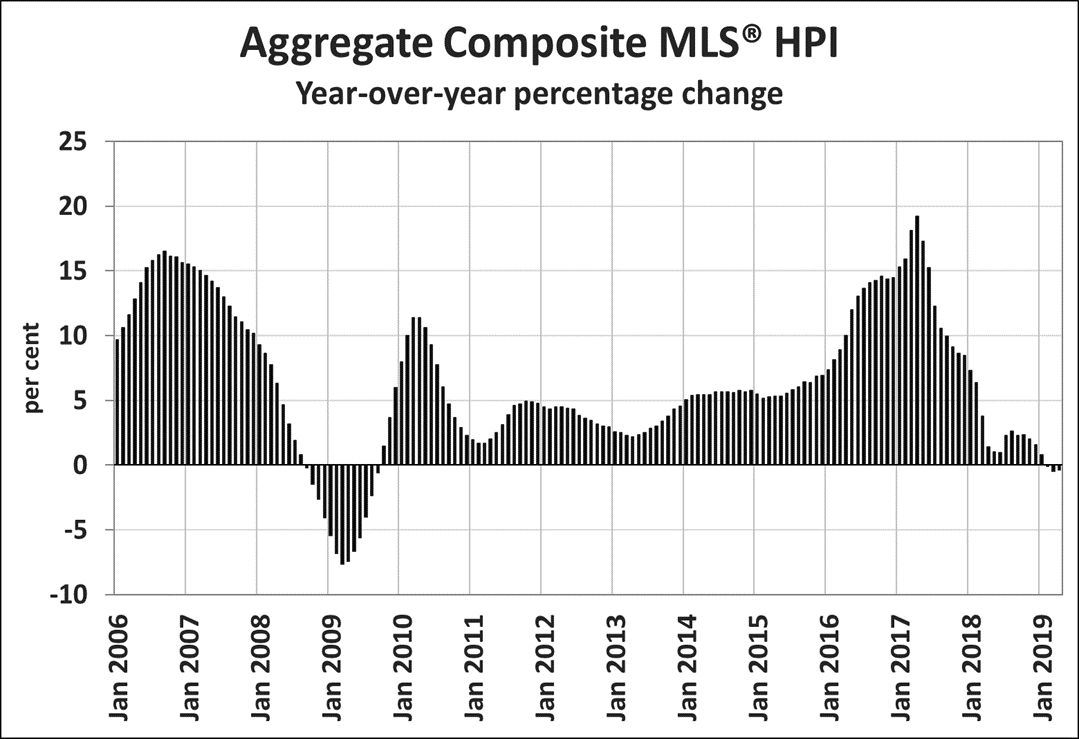
The Aggregate Composite MLS® Home Price Index (MLS® HPI) appears to be stabilizing, having edged lower by 0.3% y-o-y in April 2019. Among benchmark property categories tracked by the index, apartment units were again the only one to post a y-o-y price gain in April 2019 (0.5%), while two-storey there was little change in single-family home and townhouse/row unit prices from April 2018 (-0.3% and -0.2%, respectively). By comparison, one-storey single-family home prices were down by -1.4% y-o-y.
Trends continue to vary widely among the 18 housing markets tracked by the MLS® HPI. Results remain mixed in British Columbia, with prices down on a y-o-y basis in Greater Vancouver (GVA; -8.5%) and the Fraser Valley (-4.6%), up slightly in the Okanagan Valley (1%) and Victoria (0.7%), while climbing 6.2% elsewhere on Vancouver Island.

Among Greater Golden Horseshoe housing markets tracked by the index, MLS® HPI benchmark home prices were up from year-ago levels in the Niagara Region (6.2%), Guelph (5.1%), Hamilton-Burlington (4.6%) the GTA (3.2%) and Oakville-Milton (2.5%). By contrast, home prices in Barrie and District held below year-ago levels (-5.3%).

Across the Prairies, supply remains historically elevated relative to sales and home prices remain below year-ago levels. Benchmark prices were down by 4.6% in Calgary, 4% in Edmonton, 4.3% in Regina and 1.7% in Saskatoon. The home pricing environment will likely remain weak in these cities until demand and supply return to better balance.

Home prices rose 7.8% y-o-y in Ottawa (led by an 11% increase in townhouse/row unit prices), 6.3% in Greater Montreal (driven by a 7.8% increase in apartment unit prices), and 1.8% in Greater Moncton (led by an 11.5% increase in apartment unit prices).

Bottom Line:

The spring rebound in home sales is most evident in Toronto, where transactions climbed 11%, and prices rose 1.3%. Of 19 major markets tracked by the Ottawa-based real estate association, 16 recorded price gains last month.

One huge exception is Vancouver, which continues to soften. Benchmark home prices in that city were down 0.3% in April and have fallen 8.5% over the past 12 months. Even with the widespread rebound, national home sales are still below historical averages.

Economic fundamentals — from substantial employment gains to a sharp increase in immigration — remain supportive. Governor Poloz said earlier this week that he expects the housing markets to return to a more normal pace in the second half of this year. Benjamin Tal, the deputy chief economist at CIBC, reported yesterday that housing demand is stronger than suggested by official figures. Tal said incorrectly counting the number of students who live outside of their parents’ home for the majority of the year is problematic because it doesn’t provide a real sense of supply and demand in the country’s housing market.

Also supportive for housing is the dovish tilt globally from central banks that have helped bring down borrowing costs in recent months. Rates to renew a five-year mortgage aren’t much higher than they were when the mortgages were taken out, according to National Bank research. That means “no payment shock” for the 17.4% of mortgages renewing in 2019.

Dr. Sherry Cooper

DR. SHERRY COOPER

Chief Economist, Dominion Lending Centres

21 May

Build A Plan To Move Into Your Home

General

Posted by: Livian Smith

BUILD A PLAN TO MOVE INTO YOUR HOME

There’s nothing quite like stepping into your dream home for the very first time.

You have achieved your goal of homeownership! However, the journey from home seeker to home buyer can be challenging – unless you have a well-defined plan and guidance from the right professionals. As a mortgage broker, here’s how I will help you reach your objective:

STEP 1 GETTING TO KNOW YOU
In the discovery phase, we will discuss your situation, the essentials and “nice to haves” you’d like in your new home, and how long you plan to live there. Based on your desired move-in date, we’ll work out a timetable for your home-buying process.

STEP 2 BUILDING A BUDGET
I’ll help you create a monthly budget and then calculate a down payment and mortgage payments that fit into it. Together, we’ll also work through a financial check-up that considers how changes in income and expenses could affect your plan.

STEP 3 CUSTOMIZING THE SOLUTION
There are many different types of mortgages, and it’s important to select one that matches your current needs and preferences. I will ask you a series of questions that should help to reveal your priorities.

STEP 4 TESTING SCENARIOS
Together, we’ll try out different mortgage scenarios, and I’ll show you how changes in income, property taxes, condo fees, loans and other variables affect your maximum mortgage amount and mortgage payments. My goal is to make sure you can comfortably afford your mortgage.

STEP 5 ARRANGING PRE-APPROVAL
It’s a good idea to get pre-approval for a mortgage before you find your dream home and make an offer — that way, you can be confident that financing is available. I’ll walk you through the paperwork and guide
you towards the most suitable lender.

STEP 6 ANSWERING YOUR QUESTIONS
Now it’s time to get serious with a Realtor and view properties that fit your price range. If you have any questions along the way, be sure to give me a call.

STEP 7 SEALING THE DEAL
I’ll work closely with your Realtor & Notary to make sure everything is in place for the closing. That’s the day you pay your down payment and get the keys to your new home.

STEP 8 IT’S TIME TO MOVE IN!
From start to finish, the plan we develop together will see you through the home-buying process. Even after you’ve settled into your dream home, we’ll periodically review your current situation to determine if we need to make any alterations to your original mortgage plan

Terry Kilakos

TERRY KILAKOS

Dominion Lending Centres – Accredited Mortgage Professional

14 May

Blockbuster April Jobs Report Signals The Economy Has Turned The Corner

General

Posted by: Livian Smith

BLOCKBUSTER APRIL JOBS REPORT SIGNALS THE ECONOMY HAS TURNED THE CORNER

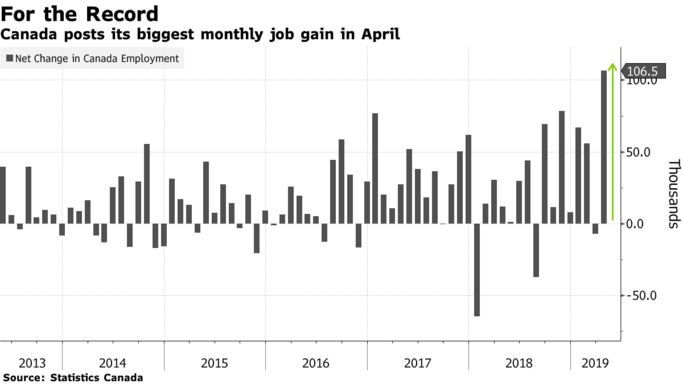
Canada posted a record job gain last month, along with a decline in the jobless rate and a pick-up in wages, providing the strongest signal yet that the economy is coming out of a six-month slowdown. Other data this week portend a rebound in economic activity, including a strong bounce-back in exports and a surge in housing starts.

Statistics Canada announced this morning that employment rose by a whopping 106,500 in April, the biggest one-month gain since the start of this data series in 1976. This was dramatically above the median forecast of economists of 12,000 net new positions. The Canadian jobless rate fell a tick to 5.7%, near a four-decade low.

This report showed broadly based strength across regions, sectors and provinces. Full-time jobs jumped by 73,000, part-time positions rose as well by 33,600.

On a year-over-year basis, employment grew by 426,000 (+2.3%), with gains in both full-time (+248,000) and part-time (+179,000) work. Over the same period, total hours worked were up 1.3%.

Employment increased in Ontario, Quebec, Alberta, and Prince Edward Island. It declined in New Brunswick and was little changed in the other provinces. Quebec posted an unemployment rate of 4.9%, the lowest in recorded history. Jobs in Alberta gained steam following two months of little change.

Employment gains were spread across several industries: wholesale and retail trade; construction; information, culture and recreation; “other services”; public administration; and agriculture. At the same time, employment decreased in professional, scientific and technical services.

Construction punched above its weight for the first time in many months. Gains were concentrated in Ontario and British Columbia. This likely foreshadows a stronger spring season in existing home sales.
Provincial Unemployment Rates
(% 2019, In Ascending Order)

Province                                      April     March
British Columbia                        4.6            4.7
Quebec                                         4.9            5.2
Manitoba                                     5.2            5.0
Saskatchewan                             5.4            4.9
Ontario                                         6.0            5.9
Alberta                                          6.7            6.9
Nova Scotia                                 6.9            6.2
New Brunswick                          8.0            7.9
Prince Edward Island               8.6            8.9
Newfoundland and Labrador 11.7            11.5

For many months the labour market strength has been the mainstay of the economy. Many had warned as recently as last month that Canada could be headed for recession amid a perfect storm of negative factors — falling oil prices, volatile financial markets, higher interest rates, cooling housing markets and global trade tensions. But many of these elements have begun to dissipate.

Exporters showed across-the-board resiliency in March after shipments tumbled in February. Toronto’s housing market, the country’s largest, is stabilizing after a recent slump. There are also signs consumers continue to spend and borrow, aided in large part by the buoyant labour market, even amid worries about the outlook.

Even wages have strengthened. Pay gains for permanent employees rose to 2.6% year-over-year, the sharpest rise since August. Total hours worked also increased, rising by 1.3% annually in April, up from 0.9% in March. Youth unemployment fell to record lows.

Bottom Line: This very positive report opens up the possibility that the Bank of Canada might take a more hawkish stance at their next meeting. It might well be that a rate hike sometime later this year is no longer off the table. One critical uncertainty, however, is the heightened trade war between the US and China. If the two sides hike tariffs sharply, a possibility given the current sabre rattling, Canada’s economy could once again be hit in the cross-fire.

Dr. Sherry Cooper

DR. SHERRY COOPER

Chief Economist, Dominion Lending Centres

14 May

Who Pays Your Mortgage Broker? Not You!

General

Posted by: Livian Smith

WHO PAYS YOUR MORTGAGE BROKER? NOT YOU!

If you’re looking to get a mortgage and considering a mortgage broker, there’s a good chance you’re wondering about how much the service costs.

Good news! Clients looking to get a standard residential mortgage pay no fees to the broker.

On standard residential mortgages, it’s 100% free for the clients. We’re paid by the bank or by the lending institution that we give the mortgage to.

But it’s not the only advantage a broker can bring you. When you’re shopping for a mortgage at a bank, they’re only able to offer you something from their stable of products. A broker, however, is able to shop at different banks to get you the best product for your needs.

If you don’t fit in the bank’s box of products, then you don’t get the mortgage. When you go to a mortgage broker, the mortgage broker has access to every lender on the market and is able to sell you basically everything to find a solution that makes the most amount of sense for you.

Because they’re able to shop around, in many cases the broker is able to find you a better rate on your mortgage.

In addition, mortgage brokers are licensed professionals covered by provincial governing bodies that looks out for you, the consumer. In many cases, the person you’re dealing with at the bank is just a salesperson, without any requirement they be licensed.

So, if you’re in the market for a new home, try a mortgage broker. It’s the safer, smarter choice for your mortgage. We’d encourage you to shop around, then get in touch with us for a no-obligation chat with a Dominion Lending Centres mortgage professional near you.

Terry Kilakos

TERRY KILAKOS

Dominion Lending Centres – Accredited Mortgage Professional

14 May

Going Long, 5 Year + Mortgages

General

Posted by: Livian Smith

GOING LONG, 5 YEAR + MORTGAGES

Recently, Stephen Poloz, the governor of the Bank of Canada stated that he felt that lenders and by offshoot, mortgage brokers, were not being creative in promoting mortgages for periods of longer than 5 years. He feels that the longer the term the less risk there is and people will be able to qualify for a renewal better after 10 years than after only 5 years.
Here’s what he does not realize. No one really wants a 10 year mortgage. Why? Because on average, Canadians move every 3 years. It may be within the same city or town but they move. Newly married couples buy starter homes. Three years later they often have one or two children and now they need more room. They move up to a bigger place. A few years down the road and they are making more money and they want an estate home. That’s the way Canadian’s lifestyles work.
I have been a broker since 2005. You know how many 10 year mortgages I have obtained for clients? One. No one is interested in that long a commitment. Back in 2006 when I arranged for my one and only 10 year mortgage, the couple wanted stability. Fair enough. They knew that with their government jobs they would not be moving for a long time. At the time, a 10 year commitment meant that the Interest Rate Differential was the most common form of getting out of these mortgages and they could be very expensive. A few years ago, the government mandated that after 5 years, the 3 month interest penalty would kick in for 10 year mortgages.
The thing is that most people find the Pros don’t out-weight the Cons on 10 year mortgages.
Let’see:

PROS – stability, Knowing that your mortgage payments will not go up for a decade while your income should go up making payments seem smaller over time. This would free up money for other things like vacations, investments and family expenses.

CONS – People move every 3 years on average and don’t want to go through the hassle of porting their mortgage or paying big bucks to break it. Many people also feel that rates are going to go lower and don’t want to lock in for such a long period of time. I checked rates and there are a number of lenders offering 10 year mortgages, the best rate at this time is 4.09%. The problem is that while that’s an amazing rate for a 10 year, most people see 5 year fixed and variable rates below 3% and they feel that over 4% is too much.

My suggestion is that if this interests you , speak to your Dominion Lending Centre mortgage professional and discuss your personal situation to see if this is an option that would benefit you.

David Cooke

DAVID COOKE

Dominion Lending Centres – Accredited Mortgage Professional

8 May

5 Things Not To Do Before Closing On Your New Home

General

Posted by: Livian Smith

5 THINGS NOT TO DO BEFORE CLOSING ON YOUR NEW HOME

1. Change your job.  You were qualified for your mortgage financing based on your income, years at the job and the understanding that you were there for a while. Changing jobs should be put off until after possession day.
2 – Changing your name. Make sure that your identification and your name match. Do not change from John Smith to J. Michael Smith during this critical time.
3- Make any large purchases. Put off buying new furniture for your future home or a new car. The debt ratios were calculated based on your present debt obligations. It can also be bad to pay off any existing accounts. Some lenders want you to have some cash in the bank for a rainy day. They may have given you an approval with this in mind.

4- Switch banks or move money to a different institution. This may not sound like much but a paper trail to show your down payment source and the automatic withdrawal forms for your mortgage payments are all set up. You can change them after the house sale closes.
5 – Don’t miss any payments on credit cards or loans you already have. Lenders often pull another credit report a few days before closing. If you’ve missed a payment on your Visa card, it could mess up your home purchase big time.
Finally, check with your Dominion Lending Centres mortgage professional if you are unclear about anything between the time when you receive your approval and possession day.

David Cooke

DAVID COOKE

Dominion Lending Centres – Accredited Mortgage Professiona

7 May

Corporations and Mortgages

General

Posted by: Livian Smith

CORPORATIONS AND MORTGAGES

For self employed clients, incorporation is a popular business structure we tend to encounter. Having a corporate structure to your business allows for effective separation between the individual and the business.

If you own your business and have it set up as a corporation, that corporation is essentially its own person. They have their own income through business revenue and have their own expenses required to carry out that business- marketing costs, material costs, office space, things of that nature.

When a corporation files taxes, they pay a lower tax rate than the personal income tax rate and only pay taxes on the net business income. The reason an individual might do this is because they do not need every dollar they earn to maintain their lifestyle. For example, if a corporation earns $150,000 and has expenses of $50,000 they pay taxes on $100,000 at the small business tax rate. If they only need to pay themselves $50,000 to maintain their lifestyle, they only pay personal income tax on the $50,000, the other $50,000 remains inside the corporation as retained earnings. If a sole proprietor earns $150,000 and has expenses of $50,000, they pay the personal income tax rate on $100,000, regardless of how much of that $100,000 they actually need.

When it comes to qualifying for a mortgage, a lender can look at the business income or the personal income they pay themselves. Adding the net business income or the personal income from year 1 and year 2 and dividing it by two is the income a lender will associate with that borrower. Keep in mind though this will also be affected if there is more than one shareholder. To find out how your income would be viewed by a lender if you have your business set up as a corporation, contact a Dominion Lending Centres mortgage professional near you.

Ryan Oake

RYAN OAKE

Dominion Lending Centres – Accredited Mortgage Professional

7 May

CMHC Changes Will Harm, Not Help, The Real Estate Market

General

Posted by: Livian Smith

CMHC CHANGES WILL HARM, NOT HELP, THE REAL ESTATE MARKET

A new program the federal government has announced to subsidize first-time homebuyers isn’t likely to help the market but more likely to harm it.

And not only is it not going to help out the market, but it’s not going to help out new homeowners.

In its recently announced budget, the government is essentially putting the weight of turning around the market on the backs of people just entering the housing market.

Part of the problem with the plan is that we only know what’s happening on the front end. People buying their first home will be eligible for a 5% top up from the from the Canada Mortgage and Housing Corporation (CMHC) to the total cost of a home. That amount increases to 10% for new constructions. To qualify, a household must have a combined income of less than $120,000, and the CMHC will only pick up a maximum of $480,000.

In exchange for this, the housing corporation gets an equity share in your home.

While we know what the government will give new homebuyers, we don’t know what it’s going to cost them down the road. Believe it or not, there’s been no announcement on what interest rates will be offered on the loans, nor what the terms of repayment would be. Complete costing isn’t expected until at least the fall, likely after the federal election.

But the real problem at the heart of this is the measures won’t do anything to help the affordability of homes. It’s not going to decrease the price of housing, and it’s just going to put the burden of propping up the market on the backs of new entrants.

In RBC’s most recent housing affordability report, released in March, the bank said a softer housing market was making houses slightly more affordable, as their national affordability index dropped 0.7 percentage points to 51.9%. (The lower the score, the more affordable homes are.)

“The fourth-quarter relief barely made a dent in Vancouver and Toronto where affordability remains at crisis levels. Owning a home in both of these markets, as well as in Victoria and increasingly Montreal, is a huge stretch for ordinary buyers,” RBC said in a press release.

In Montreal, the bank’s score is 44.5%, and RBC said the situation is not critical just yet.

“Housing affordability is eroding gradually to levels that could potentially pinch buyers—though so far they haven’t shown any sign of balking,” they said.

But with this new CMHC policy, that gradual erosion is likely to turn critical when this new wave of homebuyers crashes into the market.

One of the potential risks with this scenario is called overhang. Essentially, because a new policy has been announced, but hasn’t come into force yet, many Canadians who are likely to qualify are going to decide to put off their purchases. For now, un-bought supply will build up. But as soon as this policy goes into effect, these first-time buyers are going to suck up huge swathes of the housing market, and prices are going to skyrocket.

The new federal program is designed to lower the monthly mortgage payments of new homeowners by what amounts to a few hundred dollars a month. That can make a huge difference in the budget of a young family, but to do this, the government is putting their hands in the pockets of new homeowners for an unspecified amount, while at the same time risking further unaffordability in the housing market.

They could have had the same effect—lowering monthly payments—by re-introducing 30-year amortizations. Instead, they’ve kept the limit for CMHC-insured mortgages set to 25 years.

The shorter amortizations coupled with the continuation of the strict stress-testing rules, covered extensively in recent North East Mortgages blog posts, puts pressure on people on the lower end of the market. The stress test makes sure you can’t just handle the rate you’re signing on for, but makes sure you can handle an additional 2 percentage on top of it.

The rules the government has passed in the last few years have made it more difficult for new buyers and established buyers alike. They’ve also made it hard for people to refinance their more toxic debt, putting them into situations far riskier than the relative rarity of mortgage default.

Adjusting those rules would have a wider effect and give more people the step up they need to enter the housing market.

If the government really wanted to help with the affordability of homes, they have plenty of better options. This narrow measure is going to end up causing more harm than good.

Terry Kilakos

TERRY KILAKOS

Dominion Lending Centres – Accredited Mortgage Professional

2 May

What’s Your Best Rate?

General

Posted by: Livian Smith

WHAT’S YOUR BEST RATE?

You know at one time I could give you a quote over the phone and not worry that I would be too far out. Today is a totally different story, here are some of the variables that come into play.

1. What’s your credit score? A 700 FICO score is the new 650 for many lenders as their investors demand better quality borrowers.
2. Where is the property located? Rural areas are getting harder to finance.
3. Is it an insured file, are you putting less than 20% down payment?
4. Is it insurable? Are you putting down more than 20% on the purchase but it can qualify under the stress test, currently 5.34%?
5. Is the loan to value going to be 65% or less? You get the same rate as the guy with 5% down and have to qualify with the same criteria.
6. Are you looking to refinance or buy a rental? Sorry both are uninsurable and have to qualify at 5.34% but you have to pay a higher interest rate.
7. So how about your employment; have you been on your job or at least in the same industry for the last 2 or more years?
8. Down payment requires a 90-day statement of where it has been kept, please be sure that it was in a bank as anything else seems to be picked to death. Larger gifts lately have required the giftor to show the money was in their account. God forbid they should have won it at a casino as they will want the print out from the cage boss, especially in B.C.
9. How fast is your deal closing, as there are quick close rates usually for insured deals.
10. While supposedly everyone is to be able to qualify at 44%TDS and 39% GDS, it’s not always the case as CMHC is still in some instances lower than a 680 FICO score and is wanting the client to be qualified at the old standard of 42% and 35%, which again cuts back the qualifying amounts.

As you can see what’s your best rate has a lot of things come into play today and anyone who gives you a rate over the phone has hopefully asked you at least some of these questions. The best rate today is more about what fits your situation but the old adage of who, what, where and how still apply. Once we have asked the questions, we have to audit the answers to make sure it’s the best fit for your situation. If you have any questions, contact a Dominion Lending Centres mortgage professional near you.

Len Lane

LEN LANE

Dominion Lending Centres – Mortgage Professional

2 May

How To Pick The Best Mortgage For Your Situation!

General

Posted by: Livian Smith

HOW TO PICK THE BEST MORTGAGE FOR YOUR SITUATION!

Most Canadians are conditioned to think that the lowest interest rate means the best mortgage product. Although sometimes that is true, a mortgage is much more than just an interest rate. You can save yourself a lot of money if you pay attention to the fine print for the total cost of your mortgage.

In order to pick the best mortgage, you need to understand your options. This comes with mortgage intelligence, understanding how mortgages work and the pros and cons of the various options.
Once you’ve selected the type of mortgage, then you’ll need to shop for the most competitive option available to you and that means making some decisions based on your specific situation including:

• Are you planning to move in the next 5 years
• Will your family be growing/shrinking?
• Will your employment change and if it does will you need to relocate?
• Would thousands of dollars in penalties impact you if you need to break your mortgage?
• What types of debts do you have? Credit cards? Car loan? Student loan? Line of Credit?

Why do all this work? Because it will have a direct impact on your bottom line. A mortgage is made up of two parts—the principal and interest—you need to pay attention to how and when these parts get paid down. Ideally, you want to minimize your interest payments and maximize the principal payments.

New Government Stress Test Jan. 1, 2018 – whichever is the highest is how you must qualify for a mortgage.
• Qualify at the Chartered Bank Benchmark Rate (Government Rate) which fluctuates (currently 5.34%)
• OR the contract rate your lender gives you PLUS 2% i.e. 3.69% + 2% = 5.69%
• Since 5.69% is the highest – that would be the stress tested rate.
What this means to you is… if you have to qualify for a mortgage at a rate about 2% higher than the lender is giving you, your buying power decreases by about 20%.
To pick the best formula for your situation, you’ll first need to understand some of the factors that impact how much interest you’ll pay for your mortgage loan.

Understanding these 6 mortgage terms will help you make the best decision for your situation

Amortization

Amortization is a fancy word that means the “life of your mortgage” OR how long it takes to pay off your mortgage if you paid your mortgage for “X” years. The amount of your mortgage loan repayment is calculated based on a length of time you agree to pay off that debt. In Canada, the standard amortization period is 25 years.

• For a 30-year amortization you need a 20% or higher down payment
Picking the best mortgage is not just about qualifying for the mortgage. The amortization period is integral in the best mortgage decision because it will decide how much or how little interest you will pay during the life of the mortgage loan.
• The longer the amortization period (25 years vs 30 years) the more interest you will pay.
• Therefore, a shorter amortization period will lower your overall cost of borrowing BUT you must be able to afford the higher payments.
Once you’ve decided on your amortization, you will need to decide how frequently you would like to make your mortgage payments. Every mortgage payment (consisting of both interest and principal) will help reduce your principal (the amount of money you borrowed) and eventually reduces the overall interest you pay on this loan.
• Monthly, bi-monthly, accelerated bi-weekly or weekly mortgage payments.

Term

In the 1980’s mortgage interest rates were as high as 22%. Interest rates can change over time therefore, lenders don’t want to negotiate a 25-year loan at 4% interest if the interest rates go up to 10% in 5 years. To avoid the risk, lenders break your mortgage amortization into smaller terms.

• The term is shorter than the amortization period and locks you into your pre-negotiated rates during that time.
• The length of term you choose (most Canadians choose 5 years) will depend partly on if you think interest rates will rise or fall. Typical terms are: 1, 2, 3, 4, 5, 7 & 10.

About 3-6 months before your current term matures, your current lender usually sends you a renewal notice with options on rates for the various terms they offer (typically 1 to 10 years).
Once you get your renewal notice, you need to contact your mortgage broker to ensure you’re choosing the best option for your situation.

Closed Mortgage

A closed mortgage usually offers the lowest interest rates available.
Closed mortgages cannot be paid off before the end of its term without triggering a penalty. Some lenders allow for a partial prepayment of a closed mortgage by increasing the mortgage payment or a lump sum prepayment.

• If you try and “break your mortgage” or if any prepayments are made above the stipulated allowance the lender allows, a penalty will be charged.

Open Mortgage
An open mortgage is a more flexible mortgage that allows you to pay off your mortgage in part or in full before the end of its term without penalty, because of the flexibility the interest rates are higher.

• The interest rates for an open mortgage are typically 3-4% higher than a closed rate mortgage.
• i.e. a home buyer could pay 6.99% for a 5-year open mortgage vs. 3.99% for a five-year closed mortgage.
If you plan to sell your home soon or expect a large sum of money, an open mortgage can be a great option. Most lenders will allow you to convert from an open to a closed mortgage at any time (and switch you to lower rates).
Fixed mortgage – you have the same payment for the term of the mortgage

Variable mortgage – the mortgage rate and your monthly payments will vary depending on the Bank of Canada rate (Prime)

Fixed rate:
• Pro – you would have the same mortgage payment for the entire term of the mortgage
• Your mortgage payments are not affected by Bank of Canada Rate or Canadian Bond Yield
• Think of fixed rate as an insurance policy – you pay a premium to guarantee “fixed” rates for the balance of the term

• Pro – can port a fixed mortgage
• Con – higher interest rates
• Con – MUCH higher penalties if you need to break your mortgage (can be 4-5% of outstanding balance with Banks/Credit Unions)
• 60% of home owners, break their mortgage before it matures!
• Conclusions: How much does it cost to break a mortgage?

Variable rate:
• Pro – lower rates than the Fixed Rate – you would pay less now that you would for a Fixed Rate mortgage
• Pro – Penalty for breaking is 3 months interest (about 0.5-1% of outstanding balance).
• Pro – you can lock into a fixed rate mortgage (assuming your mortgage is in good standing) at any time, based on the amount of time remaining on your mortgage and the current posted rates.
• i.e. If you have a 5-year variable mortgage and you want to move to Fixed after 2 years, you would lock into the lenders current 3 year fixed posted rate
• Con – Cannot port a variable mortgage
• Con – Mortgage payments will increase/decrease based on the Bank of Canada rate – currently 1.75% and the lenders prime rate = Prime is currently 3.95%
• Bank of Canada meets 8 times a year
• Every 0.25% increase with the lender Prime rate will cost you an extra $13/$100,000 borrowed. i.e. $300K mortgage = will be about $39/month more/less

The best way to decide on the best mortgage is to contact your friendly neighbourhood Dominion Lending Centres mortgage broker. Mortgages are complicated, but they don’t have to be… Engage an expert!

Kelly Hudson

KELLY HUDSON

Dominion Lending Centres – Accredited Mortgage Professional