7 Mar

Making Smarter Down Payments

General

Posted by: Livian Smith

DLC BLOG

Making Smarter Down Payments

Making Smarter Down PaymentsMortgage Insurance Premiums. Many people know what they are- an extra cost to you the borrower. But not many people realize how they are calculated. Understanding the premium charges and how they are calculated will help lead you to making smarter down payments.

                                                CLICK HERE TO READ MORE 

5 Mar

Need a commercial mortgage?

General

Posted by: Livian Smith

DLC BLOG

Need a commercial mortgage?

Need a commercial mortgage?If you’re an entrepreneur, business person or commercial investor then you probably have or need a commercial mortgage.

Where should you start?

Do you call your bank, or do you call a commercial mortgage broker?

I recommend you call your bank.

Yes, that’s right; I’m a commercial mortgage broker and I am telling you to start with your bank (unless you are already out of time).

                                                CLICK HERE TO READ MORE 

3 Mar

Q4 Growth In Canada Last Year at 1.7%, Bringing Annual Growth to 3.0%

General

Posted by: Livian Smith

Dr. Sherry Cooper - Chief Economist, Dominion Lending Centres

Q4 Growth In Canada Last Year at 1.7%, Bringing Annual Growth to 3.0%

Canadian Jobs Beat Expectation in March, But Wage Growth Is Sluggish
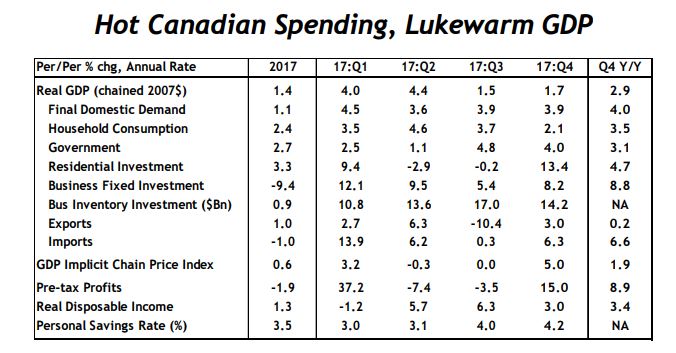
As expected, growth in the fourth quarter of last year paled in comparison to the robust performance of the first half. Statistics Canada revised up growth estimates for the first half of the year to 4.2%, from the initial estimate of 4%. Following economic expansion of a whopping 4.0% in Q1 and 4.4% in Q2, the second half slowed to a downward revised 1.5% in Q3 (posted initially at 1.7%) and 1.7% in Q4 (see table below, gratis CIBC Economics). Second half growth was about in line with the Bank of Canada’s assessment of long-run noninflationary potential growth. First-half growth was driven by robust consumer spending, particularly for durable goods, as well as strength in business investment. Residential construction was also a meaningful net contributor to expansion early last year.

The 2.9% expansion in the Canadian economy in 2017 was the fastest pace since 2011 following the tepid 1.4% growth pace of 2016. The unexpected strength allowed the federal government to post significantly smaller budget deficits for fiscal years 2017 and 2018 as announced in the October budgetary update. This week’s federal budget, however, showed that Ottawa chose to increase spending to offset these improvements, maintaining a double-digit deficit trajectory over the next five years. Rapid growth last year pushed the economy to full employment as labour markets improved dramatically. Now is not the time, therefore, for additional fiscal stimulus. Instead, it would have been more prudent to return the federal budget to a balanced position, particularly in light of potential risks to the economy in the future. As another round of NAFTA negotiations commence in Mexico city, we cannot help but be concerned about threats to Canada’s trade outlook.

Just yesterday, President Trump announced he intended to slap tariffs of 25% on steel imports and 10% on aluminium imports. Canada is the most significant supplier of foreign steel to the U.S. This announcement was roundly condemned by the international community. As always with Trump, details are uncertain, but according to Bloomberg News, the implications rippled through the seventh round of talks on the North American Free Trade Agreement in Mexico City.

Canada threatened to fire back if the U.S. makes good on this pledge, but held out hope that it could be exempt. The Canadian dollar is tied with the Mexican peso as the worst performing major currencies over the past month and is one of the worst performing over the past six months. The Canadian dollar was little changed after the GDP report.

London-based Rio Tinto, which ships more than 1.4 million metric tons of aluminium to the U.S. annually from Canada, said it would continue to lobby Washington for an exemption given the highly integrated Canada-U.S. market for autos and other manufactured goods.

“Aluminum from Canada has long been a reliable and secure input for U.S. manufacturers – including the defence sector,” Rio Tinto spokesman Matthew Klar said by email according to a report from Bloomberg News. “We will continue to engage with U.S. officials to underscore the benefits of the integrated North American aluminium supply chain, including the jobs it supports on each side of the border.” Also, shares of Canadian steel producer Stelco Holdings fell as much as 6.1%. The U.S. accounted for about 14% of Stelco’s sales in the last six months of 2017. Chief Executive Officer Alan Kestenbaum said on the company’s earnings call last week that he was hopeful Canada would be exempt from the tariffs.

Canadian Foreign Minister Chrystia Freeland fired back that, “it is entirely inappropriate to view any trade with Canada as a national security threat to the United States. Should restrictions be imposed on Canadian steel and aluminium products, Canada will take responsive measures to defend its trade interests and workers.”

Trump tweeted early this morning that, ‘trade wars are good and easy to win.’ There is not an economist in the world who agrees with this sentiment. What’s more, when U.S. prices for goods containing metals start to rise, inflation spikes and other countries start retaliating, President Trump will say “nobody knew that trade could be so complicated.” Hopefully, this is just more Trump nonsense, and cooler heads will prevail. But our government needs to have the ammo to cushion the economic effects of any such actions if NAFTA were to fall apart or Canadian businesses were hit with additional punitive tariffs. The Bank of Canada will indeed be very slow to raise rates in this environment, but fiscal stimulus should not be wasted on ineffective programs now when real stimulus might be needed as a counter-cyclical measure in the future.

The slowdown in the second half of last year was somewhat more than expected amid signs that indebted consumers have tamped down their spending sprees. Consumption growth in the fourth quarter was at its slowest pace since 2016. The deceleration in household spending was due in part to a higher savings rate, which increased to 4.2% in Q4, from 4.0% in Q3.

The underlying growth pace might be even slower than the fourth quarter figure suggests because of temporary strength in housing. Spending on residential structures surged to an annualized 13.4% in the final three months of last year, the most robust pace since 2012. The gain was led by unexpectedly strong new home construction, and the buyers rush to close home purchases before tighter mortgage qualification rules came into effect. We have already seen a marked slowdown in housing activity in the new year.

The jump in residential spending accounted for one percentage point of the 1.7% growth pace according to Statistics Canada. Residential investment had been a drag on growth in Q2 and Q3.

Exports recovered in Q4 after plunging in the third quarter, but it wasn’t enough to keep the trade sector from being a drag on growth as imports rose considerably. On a positive note, nonresidential business investment accelerated in Q4.

Dr. Sherry Cooper
Chief Economist, Dominion Lending Centres
drcooper@dominionlending.ca

Dr. Sherry Cooper
Chief Economist, Dominion Lending Centres

3 Mar

Tips for your variable rate mortgage that could save you thousands

General

Posted by: Livian Smith

DLC BLOG

Tips for your variable rate mortgage that could save you thousands

Tips for your variable rate mortgage that could save you thousandsWith changes to mortgage rules and interest rates on the rise here are some tips for your variable rate mortgage that could save you thousands.

Since 2009 the prime lending rate has shifted from a high of 6% down to 2% range remaining fairly level for the past few years before rising to a present day level of 3.45%. During that time, lenders have offered consumers high discount variable mortgage as low as 1.2% when rates were at their lowest, to current rates of 2.45 (depending on the lender and if the mortgage is insured or not).

                                                CLICK HERE TO READ MORE 

3 Mar

4 Signs You’re Ready for Homeownership

General

Posted by: Livian Smith

DLC BLOG

4 Signs You’re Ready For Homeownership

4 Signs You’re Ready For HomeownershipWhile most people know the main things they need to buy a home, such as stable employment and enough money for a down payment, there are a few other factors that may help you realize you’re ready, perhaps even earlier than you thought!

                                                CLICK HERE TO READ MORE 

28 Feb

The Activist Budget—There Is No Problem This Government Cannot Fix

General

Posted by: Livian Smith

Dr. Sherry Cooper - Chief Economist, Dominion Lending Centres

The Activist Budget—There Is No Problem This Government Cannot Fix

May's employment growth builds on gains since July 2016
Patting himself on the back, the Finance Minister opened his speech by reminding us that “a little over two years ago…Canadians had the opportunity to stay the course. They could stick with a Government that favoured cuts and a set of failed policies that produced stubborn unemployment and the worst decade of economic growth since the depths of the Great Depression.” This, of course, was Stephen Harper’s Conservative Government. Never mind that the global financial crisis caused the recession, not the “failed policies” of the previous government. Throughout the budget documents, the message is that austerity was “needless” or “excessive.” Instead, Canadians chose, “a more confident and more ambitious approach…that gave Canadians the tools they needed to succeed. Starting with raising taxes on the wealthiest, so we could lower them for the middle class.”

The Liberals have forgotten their promise to run deficits no larger than $10 billion and to balance the budget by 2019. Instead, they now see sound fiscal management as a declining debt-to-GDP ratio—never mind that double-digit deficits remain as far as the eye can see—to a stunning $12.3 billion deficit at the end of the forecast horizon in fiscal year (FY) 2022-23.

The deficit figures have indeed improved—down more than $2.0 billion in FYs 2017 and 2018–thanks to the stronger-than-expected economy and rapidly reduced unemployment last year. But, initiatives in today’s federal budget add $6.3 billion to the current year’s (ending March 31, 2018) budget deficit, $5.4 billion to next year’s federal red ink and an additional $2.0-to-$3.0 billion annually over the forecast horizon ending in FY 2022-23 (see Table below).

Fortunately, Canada has by far the lowest debt-to-GDP ratios in the G7, reflective of the austerity programs of the past, beginning in the mid-1990s and continuing until the financial crisis in 2008-09 when counter-cyclical global fiscal policy was essential to assure financial stability and rebounding economic activity by late-2009. While the U.S. and much of the rest of the developed world suffered the longest and deepest recession since the Great Depression, Canada’s was the shortest and mildest recession in the postwar period—contrary to the impression left by the Finance Minister in his opening remarks.

Thanks to this backdrop, the debt-to-GDP ratio in Canada will continue to decline despite continued fiscal stimulus. The ratio is forecast to gradually edge downward from 30.4% this year to 28.4% in 2022-23, assuming the economy continues to grow. Clearly, all bets are off if we hit a pothole, such as the end of NAFTA or a recurrence of plunging oil prices.

Budget 2018 proposes to:

• Put more money in the pockets of those who need it the most, by improving access to the Canada Child Benefit and introducing the Canada Workers Benefit, a stronger and more accessible benefit that will replace the Working Income Tax Benefit.

• Make significant progress towards equality of opportunity, by taking leadership to address the gender wage gap, supporting equal parenting, tackling gender-based violence and sexual harassment, and introducing a new entrepreneurship strategy for women.

• Support the next generation of researchers, by providing historic funding to increase opportunities for young researchers and provide them the equipment they need, while strengthening support for entrepreneurs to innovate, scale up and reach global markets.

• Advance reconciliation with Indigenous Peoples, by helping to close the gap between the quality of life of Indigenous and non-Indigenous people, providing greater support to keep First Nations children safe and supported within their communities, accelerating progress on clean drinking water, housing, and employment, and supporting recognition of rights and self determination.

• Protect the environment for future generations, by making historic investments to preserve our natural heritage, ensuring a price is put on carbon pollution across Canada, and extending support for clean energy projects.

• Uphold Canada’s shared values and support the health and wellness of Canadians, by partnering with provinces and territories to address the opioid crisis, taking action to advance national pharmacare, and bolstering support for Canada’s official languages.

This list summarizes 367 pages of more than 100 relatively small government initiatives impacting everything from Workers Benefits payments to low-income families, improving access to the Canada Child Benefit to supporting opportunities for women, pay equity for federal workers, strengthening trade, improving worker skills, and cracking down on tax evasion—all of this among the roughly 25 government actions described in Chapter 1 under the heading of Growth. The details of changes in the rules regarding the holding of passive investments inside private corporations as well as closing tax loopholes fall under this Growth rubric.

Chapter 2, called Progress, includes more than 35 initiatives under the headings of Investing in Canadian scientists and researchers, Stronger and more collaborative Federal science, and Innovation and Skills Plan—a more client-focussed Federal partner for business.

Chapter 3, Reconciliation, largely deals with Indigenous Peoples, including roughly 20 actions.

And finally, Chapter 4, called Advancement, covers the environment under Canada’s Natural Legacy, Canada and the World, Upholding Shared Values, and Security and Access to Justice. I lost count here at over 40 initiatives.

And, that’s not all! A bonus section called Equality, goes into detail regarding Canada’s commitment to gender budgeting, which includes $6.7 million over five years for “Statistics Canada to create a new Centre for Gender, Diversity and Inclusion Statistics, a Centre that will act as a Gender Budget Accounting data hub to support future, evidenced-based policy development and decision-making”.

I kid you not. At my rough count, I have been to 34 budget lock-ups, but I can’t remember ever seeing anything like this for sheer magnitude of the number of relatively tiny initiatives, nor can I ever remember leaving a lock-up with such a screaming headache.

Dr. Sherry Cooper
Chief Economist, Dominion Lending Centres
drcooper@dominionlending.ca

Dr. Sherry Cooper
Chief Economist, Dominion Lending Centres

28 Feb

Fixed versus variable interest rates

General

Posted by: Livian Smith

DLC BLOG

Fixed versus variable interest rates

Fixed versus variable interest ratesFixed Interest Rates

This is usually the more popular choice for clients when it comes to deciding on which type of interest rate they want. There are many reasons why, but the most unsurprising answer is always safety. With a fixed interest rate, you know exactly what you are paying every month and you know that the amount of interest being charged for the term of your mortgage will not increase and it will not decrease.

                                                CLICK HERE TO READ MORE 

26 Feb

What is a Collateral Mortgage?

General

Posted by: Livian Smith

DLC BLOG

What is a Collateral Mortgage?

What is a Collateral Mortgage?A collateral mortgage is a way of registering your mortgage on title. This type of registration is sometimes used by banks and credit unions. Monoline lenders, on the other hand, rarely register your mortgage as a collateral charge – which is an all-indebtedness charge that allows you to access the equity in the home over and above your mortgage, up to the total charge registered.

                                                CLICK HERE TO READ MORE 

23 Feb

6 Reasons To Get A Home Inspection Before You Buy

General

Posted by: Livian Smith

DLC BLOG

6 Reasons To Get A Home Inspection Before You Buy

6 Reasons To Get A Home Inspection Before You BuyIn an active housing market sometimes buyers are urged by their realtors to make an offer with no conditions. As a mortgage broker this always makes my heart skip a beat. I know from experience that financing can go sideways and you need to be sure it’s in place before removing conditions.
Another item that should not be forgotten is a house inspection. You may have a good eye for décor but house inspections are not for amateurs. We have all heard, “Never judge a book by its cover” so why would you make the most important purchase in your life without checking it out? This may be the best $300-$500 you ever spent. Here’s why.

                                                CLICK HERE TO READ MORE 

23 Feb

Foreclosure Not Automatic on Default

General

Posted by: Livian Smith

DLC BLOG

Foreclosure Not Automatic on Default

Foreclosure Not Automatic on DefaultAccording to a recent case tried in the Court of Appeal for Ontario, Winters v Hunking, 2017 ONCA 909 as summarized by Scott McGrath of WeirFoulds LLP, Foreclosure is not automatic on default.

In an interesting article posted December 8, 2017 in Mondaq, Scott McGrath reminds us that the Court may have acknowledged the Lender was within their rights to commence foreclosure proceedings, but special circumstances “made such a foreclosure unjust in the circumstances”.

                                                CLICK HERE TO READ MORE